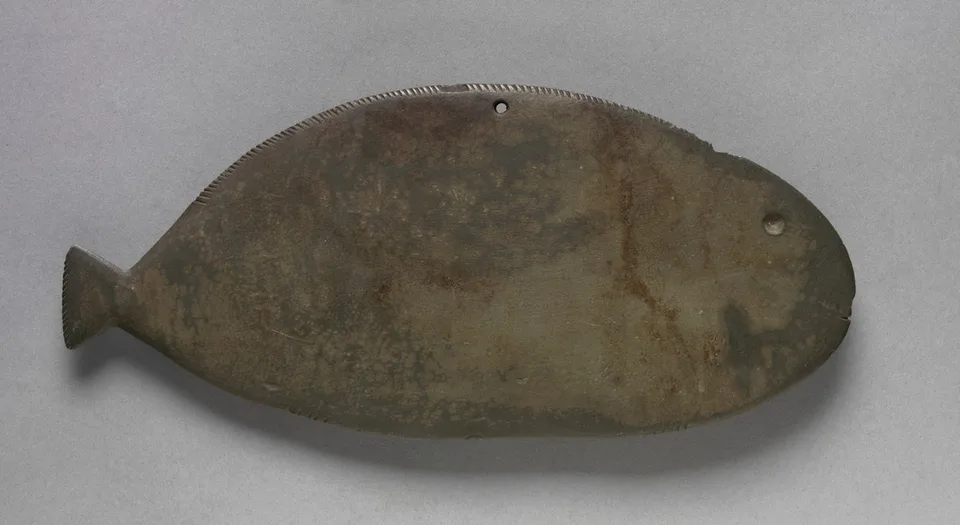
 Egypt, Predynastic (5000–2950 BCE), Naqada II–III (3650–3000 BCE) · c. 3500–2950 BCE
Palette in the Form of a Fish
Maker unrecorded
graywacke
A largely plain centre can be the most purposeful part of an object. The Egyptian palette provided a grinding surface; the Yorùbá tray held powder for changing divinatory marks. Their shaped and carved boundaries make that working space visible without giving the two practices a common meaning.
Egypt, Predynastic (5000–2950 BCE), Naqada II–III (3650–3000 BCE) · c. 3500–2950 BCEMaker unrecorded
graywacke
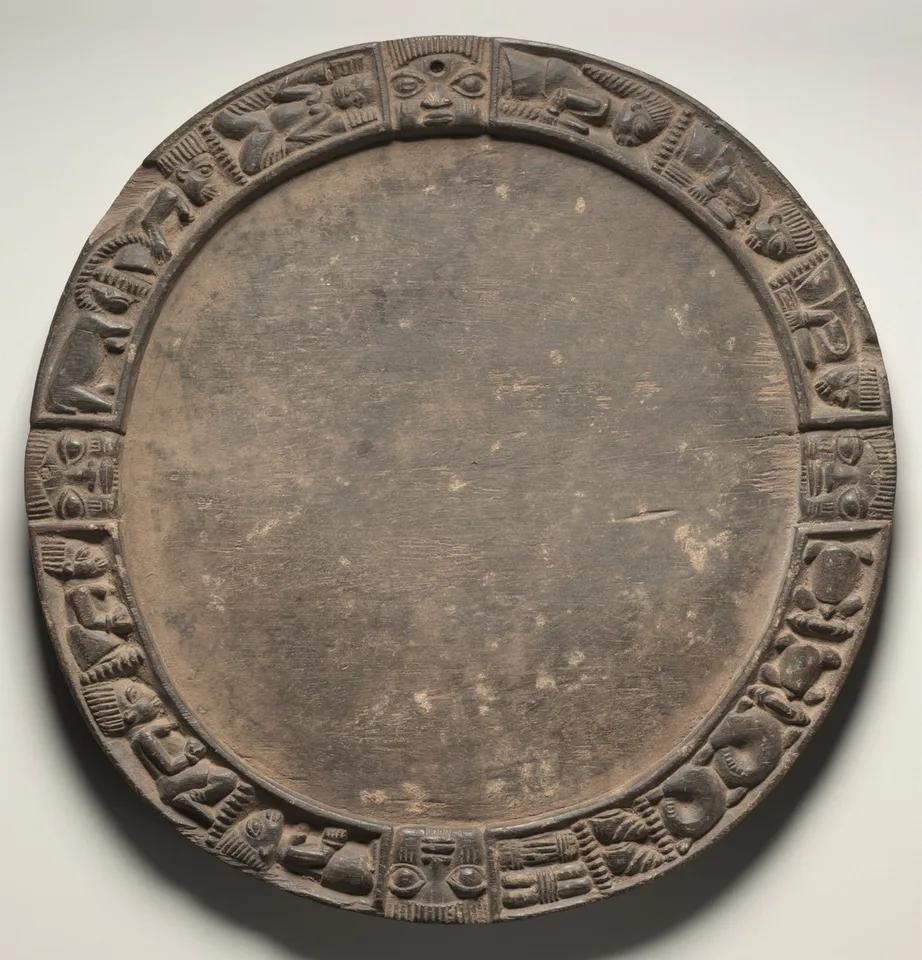 Africa, West Africa, Nigeria, Yorùbá-style maker · 1900s
Maker unrecorded
wood
The fish palette’s broad flat body leaves room for pigment preparation. The tray’s worn central circle leaves room for powder and marks. In both, absence of permanent central ornament enables an action rather than indicating an unfinished design.
A small eye establishes the fish near its rounded head. Four larger faces organize the tray’s rim and are identified by the museum as Èṣù. Both use facial features outside the main field, but only the tray’s faces have this specific divinatory identity.
The palette’s forked tail extends an animal outline beyond its working body. The tray’s narrow border carries figures and creatures around the open field. One relies on silhouette, the other on a dense carved sequence interpreted through Ifá practice.
Grinding eye-paint minerals and performing Ifá divination are different activities in distant contexts. The comparison is about purposeful open surfaces, not a shared ritual system.
The comparison of visible choices is our own reading. Follow either artwork page for its full context, uncertainty note and image-rights record.
From a model boat and comb to divination and ancestral images.
Five ways to divide a modest object between image and practical use.