Read the
Picture
An open collection
Africa, West Africa, Nigeria, Yorùbá-style maker · Sculpture

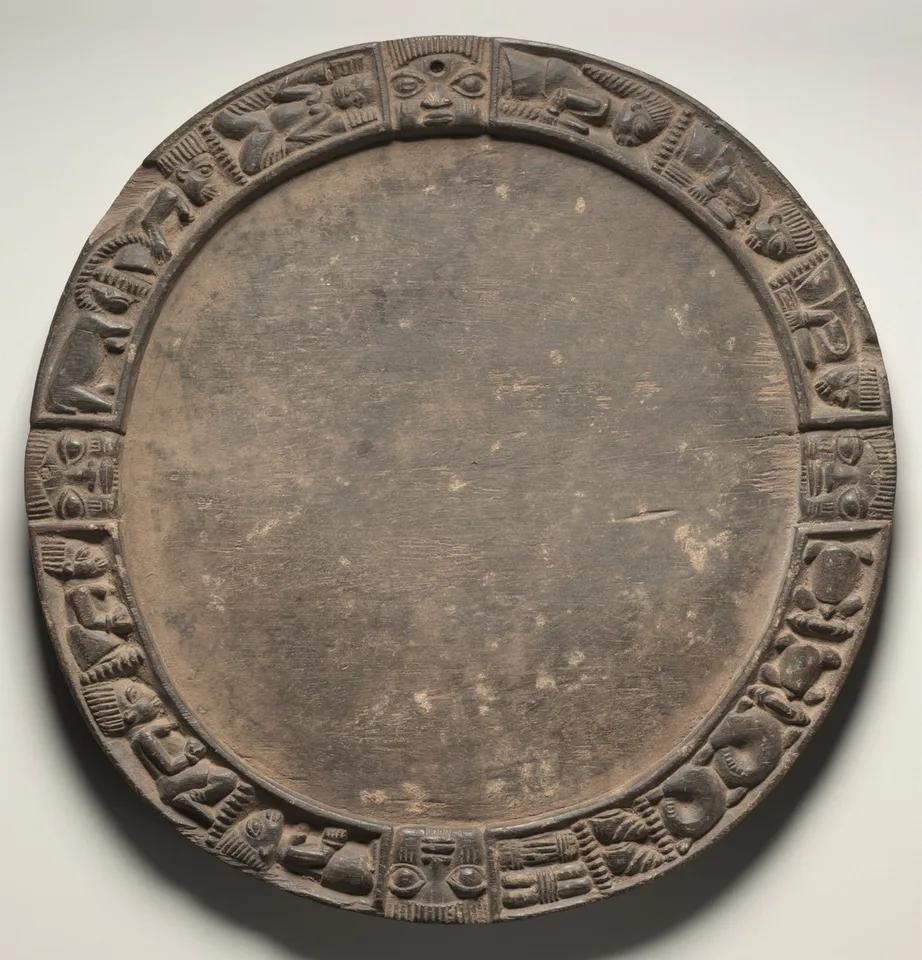
Divination Tray (ọpọ́n Ifá)

Maker unrecorded · 1900s

A circular wooden tray has a broad plain centre surrounded by a raised carved border. Four large faces occur at roughly equal intervals around the rim. Smaller human and animal forms fill the spaces between them. The central surface is worn and scratched, contrasting with the densely incised outer band.
100%

Drag to move · Pinch or +/− to zoom · Arrow keys to pan · 0 to reset

The Cleveland Museum of Art · 1993.235 · Image: CC0Museum image ↗
A little context

A smooth working field is enclosed by a busy carved rim, where faces and small figures surround an intentionally open centre.

In Ifá divination, a priest spread wood powder across a tray’s smooth inner field and marked it as sacred palm nuts were cast. The resulting signs guided the chants to be recited. The museum identifies the four faces around this tray’s rim as Èṣù, who oversees the divination process and carries sacrifices to the gods. The centre’s openness was therefore purposeful: it provided a surface for changing marks rather than a space awaiting permanent decoration.

The carved rim establishes a contrasting zone of fixed images. Human figures and creatures occupy narrow compartments between the prominent faces. The museum interprets kneeling people as probable petitioners and identifies turtles, mudfish and snails among the animals. Their ability to occupy land or water relates, in this particular account, to the diviner’s connection between human and spiritual worlds. Begin with the clear visual distinction between working field and raised border, then let the source supply meanings that the worn carving alone cannot securely explain.

A careful reading

The photograph shows the tray without powder, palm nuts or a diviner. Some small figures are worn, and the museum qualifies its identification of the kneeling people as petitioners.
Try your eye

Why does the plain centre matter to the tray’s design?

Where this reading begins

  • Divination Tray (ọpọ́n Ifá): collection record — The Cleveland Museum of Art. Identification, qualified cultural and maker attribution, materials, object-specific historical context, provenance and stated uncertainties; photograph independently inspected for visual observations. Museum record updated 2026-05-29; accessed 2026-11-14.

Our observations describe the supplied museum photograph. Historical identifications and context follow the cited collection record; interpretive limits are stated above. This is an independent guide, not a museum endorsement.

Image rights & attribution

Divination Tray (ọpọ́n Ifá), 1900s. Africa, West Africa, Nigeria, Yorùbá-style maker. Wood; diameter: 42 cm (16 9/16 in.); overall: 3.2 cm (1 1/4 in.). The Cleveland Museum of Art, Gift of Drs. James and Gladys Strain, 1993.235

Individual API record marked CC0; checked 2026-11-14. CC0 1.0 dedication. Record date: 2026-05-29 08:10:34.570000. Museum print JPEG preserved unchanged in local originals; overview JPEG resized and recompressed from that same full frame; responsive WebP and zoom derivatives resized and recompressed; numbered annotation overlay separate from image.