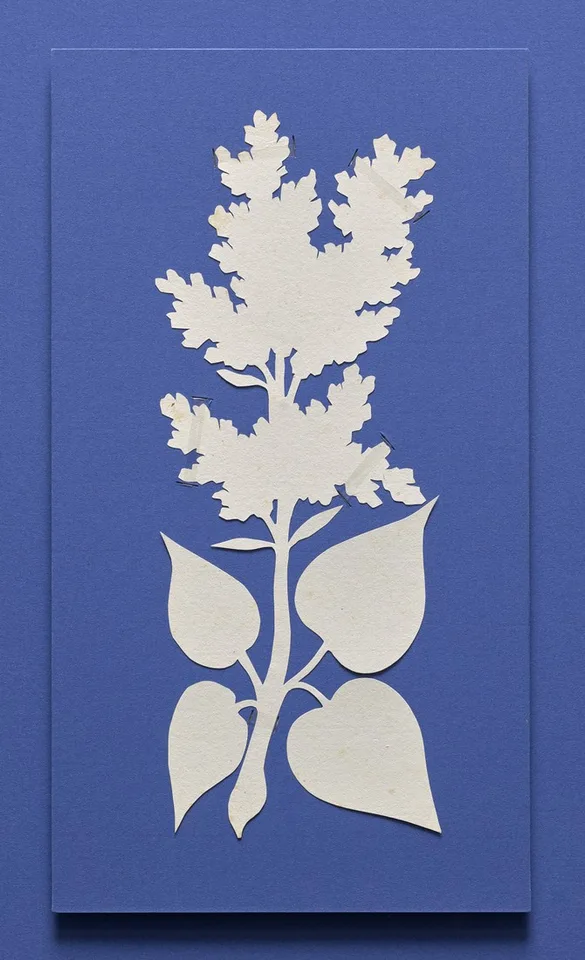
 Germany · 1800–1805
Lilac
Philipp Otto Runge (German, 1777–1810)
Silhouette cut from off-white laid paper mounted to modern blue laid paper
Both works reward attention to small natural forms, but one depends on cut contour and the other combines colored observation with composed insect relationships. Compare how each medium decides which information becomes visible.
Germany · 1800–1805Philipp Otto Runge (German, 1777–1810)
Silhouette cut from off-white laid paper mounted to modern blue laid paper
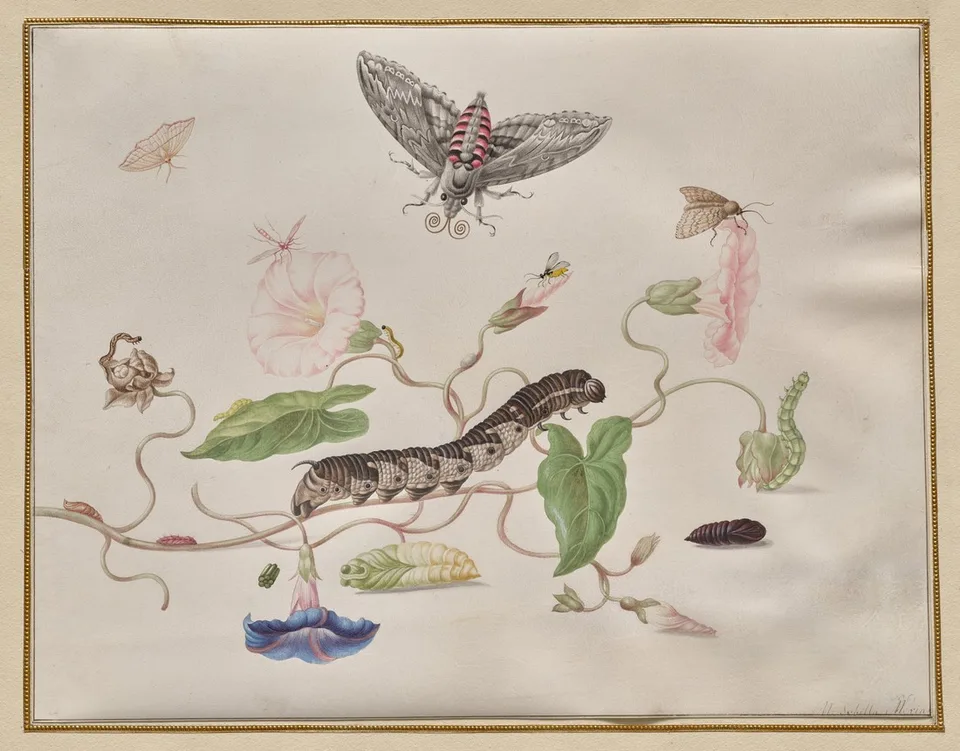 Netherlands · c. 1670–90
Maria Sibylla Merian (German, active Netherlands, 1647–1717)
watercolor with touches of opaque watercolor over indications in black chalk or graphite on vellum
Runge’s unmarked heart-shaped leaf depends on its edge against the backing. Merian’s morning glory uses colored washes, veins, and a curling stem. Both make a plant readable, but contour carries a different share of the descriptive work.
Runge cuts many small projections to suggest clustered blossoms. Merian paints patterned moth wings and a striped abdomen above the plant. Their detail is precise, yet the material operations are subtraction from paper and accumulation of colored marks.
Runge’s narrow stem physically connects the cutout’s leaves and flowers. Merian places caterpillars along plant stems, but not all belong to one species. A visible connection can be structural in one object and an arranged relationship requiring scientific qualification in another.
The lilac’s blue backing is modern, and Merian added other caterpillar species for composition. Neither work should be treated as an unmediated record of one natural moment.
The comparison of visible choices is our own reading. Follow either artwork page for its full context, uncertainty note and image-rights record.
Fruit, flowers, utensils, and the people who look past them.
Cut paper, printed linen, glass, horn, and tapestry.