Read the
Picture
An open collection
Germany · Other

Lilac

Philipp Otto Runge (German, 1777–1810) · 1800–1805

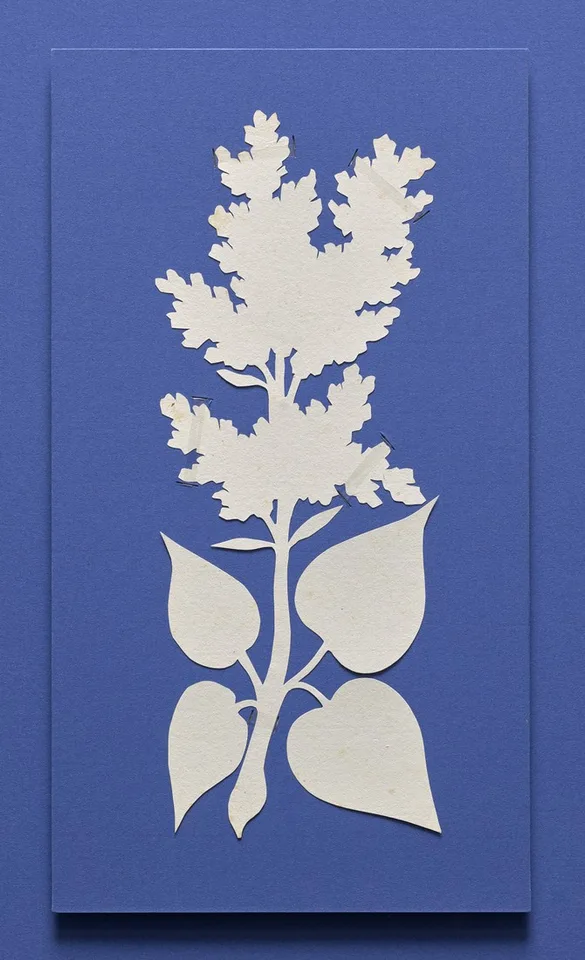
An off-white paper silhouette of a lilac sprig is mounted against deep blue paper. A thin stem branches into four large heart-shaped leaves and several clusters of tiny irregular blossoms. The flower edges are intricately cut, while the leaf surfaces remain plain. A raised rectangular blue mount casts a small shadow below.
100%

Drag to move · Pinch or +/− to zoom · Arrow keys to pan · 0 to reset

The Cleveland Museum of Art · 2023.120 · Image: CC0Museum image ↗
A little context

Tiny cut petals and broad unmarked leaves show how a sheet of paper can describe a plant through its edge alone.

The lilac has no modeled shadows within its leaves. Their shapes depend entirely on the contrast between pale paper and blue ground. At the top, clusters of small cuts make the blossoms more intricate, while narrow branches preserve a continuous connection through the whole sprig. The technique asks the eye to read contour and spacing instead of painted volume.

Runge made more than a hundred plant silhouettes using a folk practice he learned from his mother. The museum records this example as a gift to the Speckter family of artists in Hamburg. Its domestic and social history is part of its significance: artistic exchange can take the form of a delicately cut plant, not only a grand commissioned painting. The blue mounting paper is modern, however, so the present contrast includes a later display decision. The surviving cutout and its current support should be understood as related but historically separate materials.

A careful reading

The blue backing is modern, according to the medium record. Its present color contrast should not be assumed to reproduce Runge’s original gift or mounting arrangement.
Try your eye

What principally describes the plant’s form?

Where this reading begins

  • Lilac — collection record — The Cleveland Museum of Art. Documents cut silhouette practice learned from mother, more than 100 plants, Speckter gift and modern blue-paper support. 2026-05-29; accessed 2026-11-16.

Our observations describe the supplied museum photograph. Historical identifications and context follow the cited collection record; interpretive limits are stated above. This is an independent guide, not a museum endorsement.

Image rights & attribution

Lilac, 1800–1805. Philipp Otto Runge (German, 1777–1810). Silhouette cut from off-white laid paper mounted to modern blue laid paper; sheet: 39.4 x 27 cm (15 1/2 x 10 5/8 in.); matted: 55.9 x 40.6 cm (22 x 16 in.). The Cleveland Museum of Art, John L. Severance Fund, 2023.120

Individual API record marked CC0; checked 2026-11-14. CC0 1.0 dedication. Record date: 2026-05-29 09:11:11.690000. Museum print JPEG retained unchanged as original. Overview JPEG and responsive WebP and zoom derivatives resized and recompressed from that same complete print photograph; numbered annotation overlay separate from image.