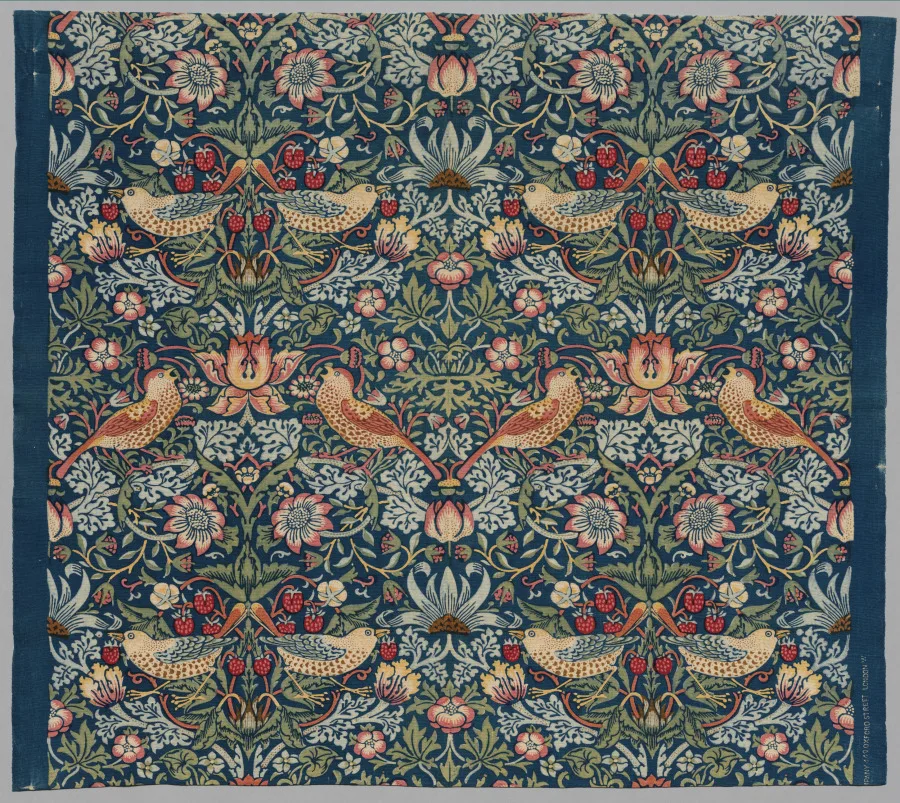
 England, Merton Abbey, 20th century · c 1936
Strawberry Thief
William Morris (British, 1834–1896), designer
plain weave cotton, discharge printed
Birds, plants, and fantastic creatures become furnishing surfaces through repetition. Compare two Morris designs across cotton printing and wool weaving, while keeping an actual object’s date distinct from the invention of its pattern.
England, Merton Abbey, 20th century · c 1936William Morris (British, 1834–1896), designer
plain weave cotton, discharge printed
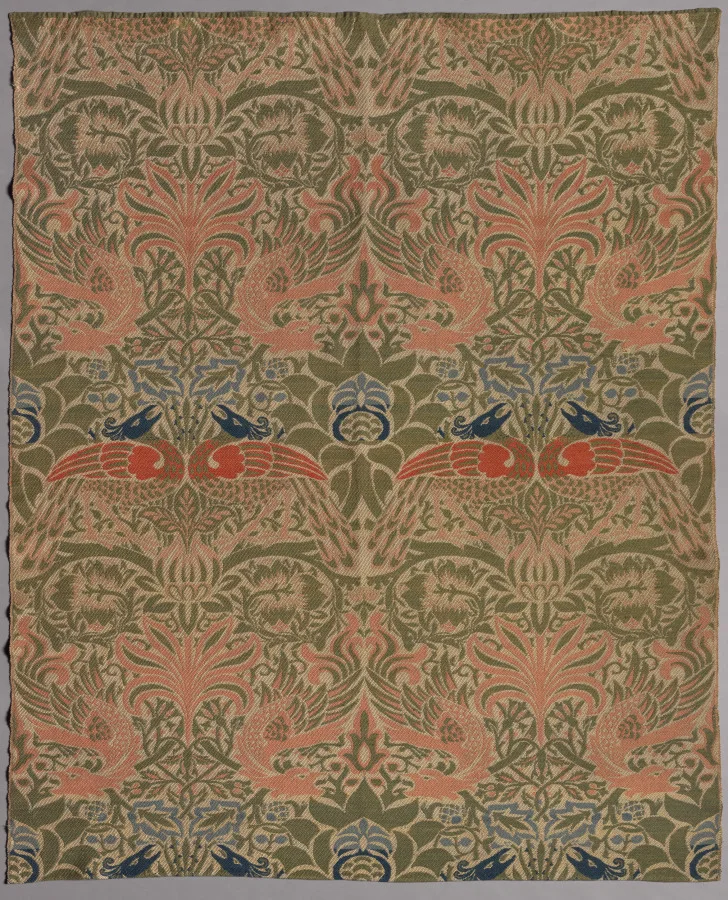 England, Surrey, Merton Abbey · 1878
William Morris (British, 1834–1896), designer
weft-faced compound twill; wool
Strawberry Thief pairs birds among fruit and curling stems; Peacock and Dragon arranges facing birds within another branching framework. Mirroring gives each lively subject a repeatable order. Follow one pair to the next to see how a local motif begins to organize an extended surface.
The strawberry design draws on garden thrushes, while the second textile includes fantastic winged creatures. Both are stylized for use in a pattern. A natural source does not require botanical literalness, and an imaginary creature can still obey a precise decorative structure.
Strawberry Thief begins with blue-dyed cotton that is discharged and printed with additional colors. Peacock and Dragon uses a substantial wool weave associated with warming wall hangings. The visual repeat is only one part of each object; surface, weight, and production also shape its intended encounter.
The Strawberry Thief cloth is dated around 1936, after Morris’s death, and credits him as designer. Shared authorship of designs does not mean he personally manufactured either surviving textile.
The comparison of visible choices is our own reading. Follow either artwork page for its full context, uncertainty note and image-rights record.
Printed cotton, woven wool, glass in paint, and ink ask for different kinds of looking.
A stag, a jungle, a mountain and a textile take different routes from nature into art.