Read the
Picture
An open collection
England, Surrey, Merton Abbey · Textile

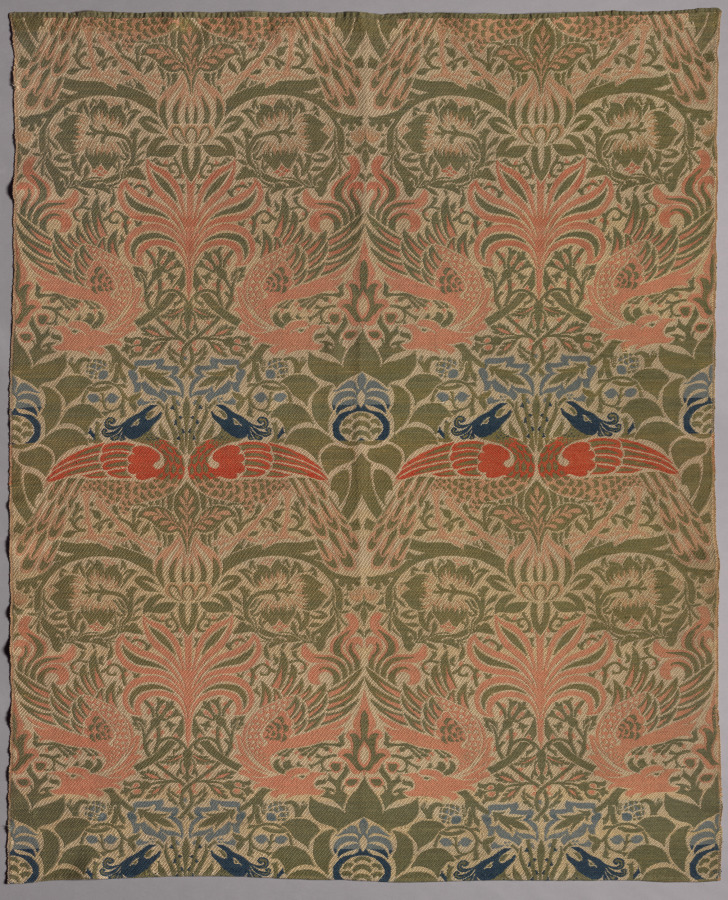
Peacock and Dragon

William Morris (British, 1834–1896), designer · 1878

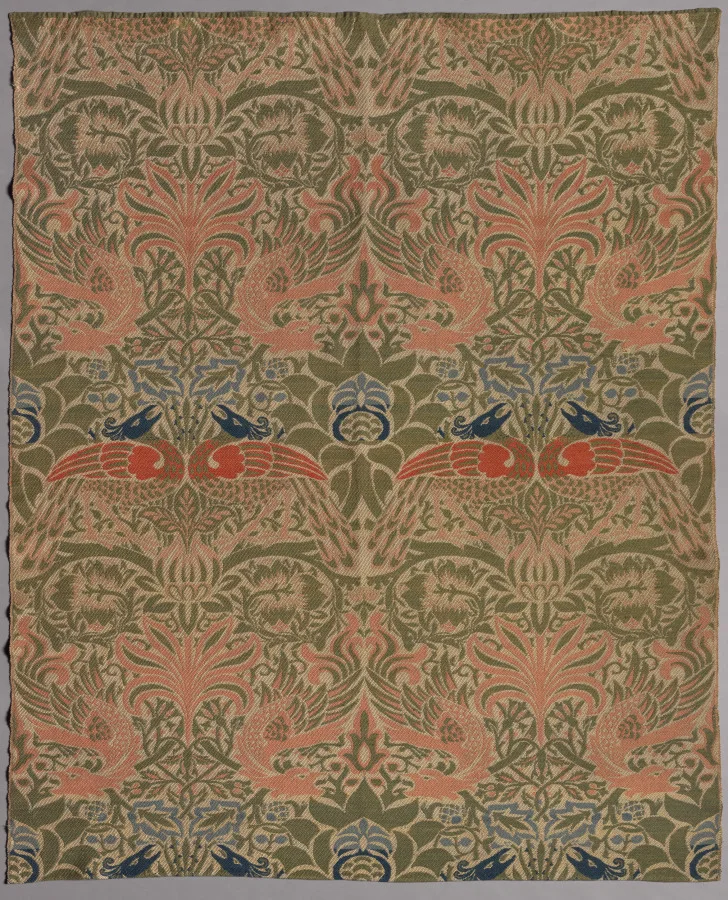
A tall wool textile repeats paired red and blue birds, red winged creatures, and dense curling green plants on a muted pale ground. Large flower forms divide the mirrored animals into horizontal bands. The surface appears soft and woven, with slight irregularities and a narrow dark edge visible along the left.
100%

Drag to move · Pinch or +/− to zoom · Arrow keys to pan · 0 to reset

The Cleveland Museum of Art · 1953.330 · Image: CC0Museum image ↗
A little context

Peacocks and dragons share a repeating wool surface designed to give a room both visual richness and physical warmth.

The animals arrive in pairs. Birds face one another beneath branching plants, while winged creatures repeat in another band above. Red, blue, and green forms share a muted ground, so the pattern remains rich without depending on bright white contrast. The thick wool surface adds a material character that a flat reproduction can only partly convey.

The museum explains that Morris wanted textiles to provide the warmth he associated with medieval wall hangings. It also traces part of this design’s inspiration to a reconstructed Damascus room he saw in a London dealer’s shop. The result is neither a direct medieval survival nor a neutral copy of one Syrian interior. It is a nineteenth-century design assembled from historical interests, mediated encounters, and practical goals for furnishing. Compare the repeated creatures with the branching framework around them: the living and fantastic subjects are held within a measured structure intended to cover and transform a room’s surfaces.

A careful reading

Morris’s medieval ideal and the Damascus-room inspiration describe his design sources, not the textile’s place of origin. Preserve his role as designer and avoid presenting the pattern as a faithful record of one historical culture or interior.
Try your eye

Which distinction is essential to the textile’s context?

Where this reading begins

  • Peacock and Dragon — collection record — The Cleveland Museum of Art. Documents wool compound twill, paired design, warming wall-hanging ideal and inspiration from a reconstructed Damascus room seen in London. 2026-05-29; accessed 2026-11-16.

Our observations describe the supplied museum photograph. Historical identifications and context follow the cited collection record; interpretive limits are stated above. This is an independent guide, not a museum endorsement.

Image rights & attribution

Peacock and Dragon , 1878. William Morris (British, 1834–1896). Weft-faced compound twill; wool; overall: 206.6 x 174.7 cm (81 5/16 x 68 3/4 in.). The Cleveland Museum of Art, Gift of Mrs. Philip White, 1953.330

Individual API record marked CC0; checked 2026-11-13. CC0 1.0 dedication. Record date: 2026-05-29 06:45:21.201000. Web JPEG downloaded unchanged; responsive WebP and zoom derivatives resized and recompressed; numbered annotation overlay separate from image.