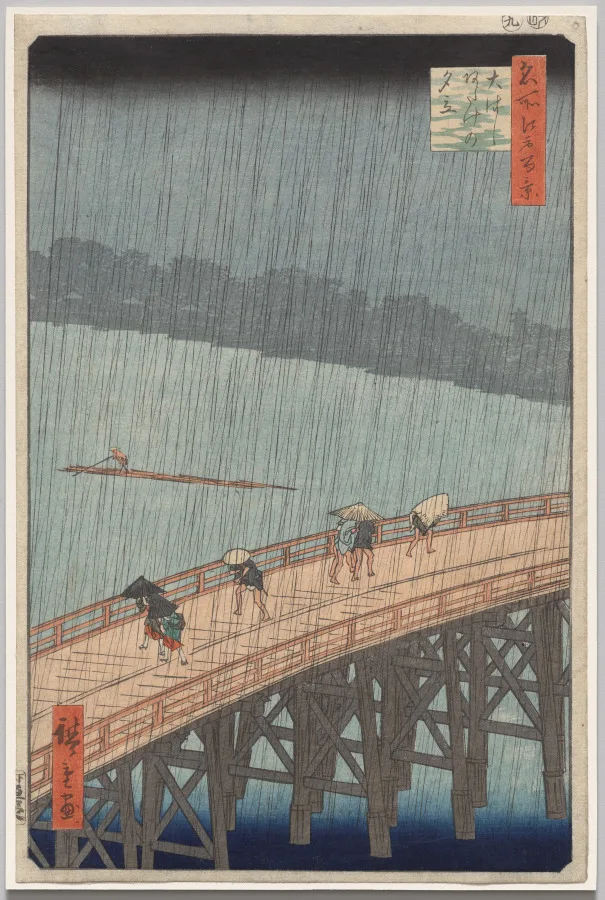
 Japan, Edo period (1615–1868) · 1857
Sudden Shower over Shin-Ōhashi Bridge and Atake, from One Hundred Famous Views of Edo
Utagawa Hiroshige (Japanese, 1797–1858)
color woodblock print
Both images make an unstable event legible, but their materials and visual strategies differ. Compare how repeated lines suggest a downpour and how swathes of colour suggest fire-lit air. People and architecture give each event scale; the London fire is a historical disaster, not simply a kind of weather.
Japan, Edo period (1615–1868) · 1857Utagawa Hiroshige (Japanese, 1797–1858)
color woodblock print
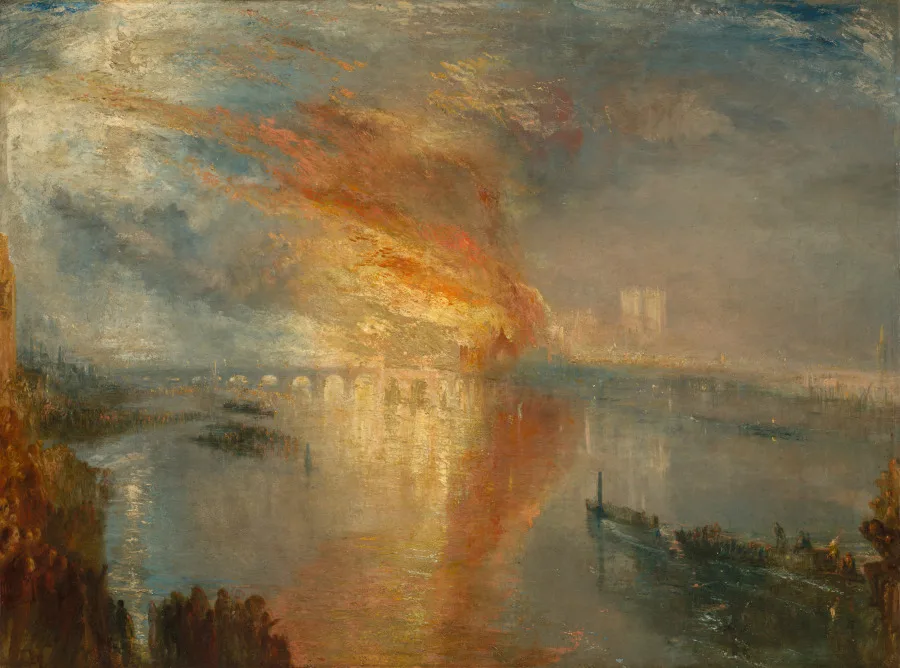 England, 19th century · 1835
Joseph Mallord William Turner (British, 1775–1851)
oil on canvas
In Sudden Shower, diagonal rain lines cross the scene in a repeated direction. In Turner’s painting, broad areas of light and darker atmosphere interrupt clear edges. Both organise the whole image rather than decorating an already complete view.
Hiroshige’s small walkers shelter beneath coverings on the bridge; Turner’s small boats and upright figures head toward the blaze. These figures turn weather and atmosphere into situations people encounter. Compare how their small scale enlarges the surrounding event.
The bridge’s substantial timber supports give Hiroshige’s print a firm structure beneath the crossing. Turner places watching spectators at the near riverbank. Both provide a way into a scene whose atmosphere is unstable, but one centres a route through a city and the other a public act of watching.
These works do not document the same kind of event. A designed print and a painted response to a historical fire also involve different production and circulation histories.
The comparison of visible choices is our own reading. Follow either artwork page for its full context, uncertainty note and image-rights record.
Let the material change the questions you ask.
A view is constructed, not simply copied.