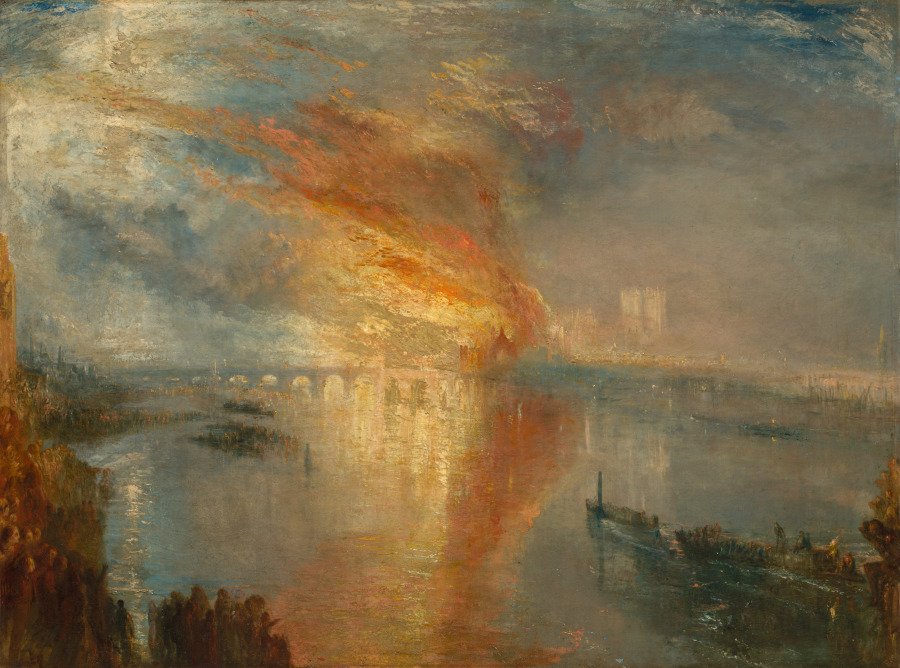
Look beyond the spectacular flames to the tiny boats, where a real emergency becomes visible inside Turner’s sweeping color.
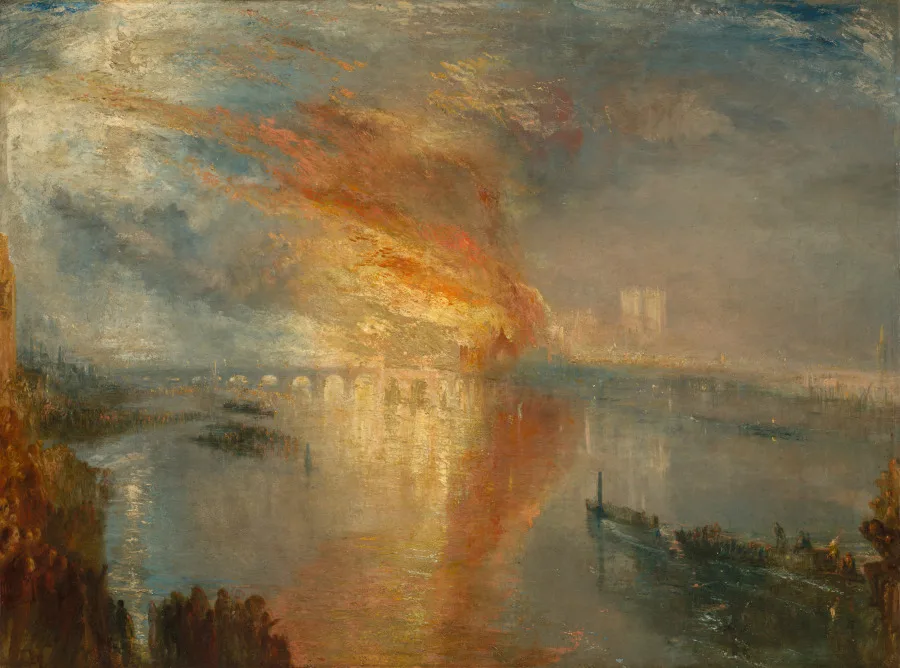
A great column of flame rises over the Thames, but start with the small boats at the lower right. They give the fire scale and turn an apparently abstract swirl of color into an event involving people. Turner painted the burning of London’s Houses of Parliament in October 1834. The museum explains that low water initially obstructed firefighting efforts, while spectators gathered along the riverbanks to watch the blaze.
This painting is not a neutral record of the fire’s dimensions. Turner heightened the flames, using an actual disaster as material for an overwhelming encounter with destructive forces. Pale architecture seems fragile beside the orange mass; the river doubles the spectacle in reflection. The eye can move from recognizable vessels and spectators into passages where buildings, smoke, and light are difficult to separate. That change in clarity is part of the painting’s effect: human actions remain legible, but the event threatens to exceed the picture’s orderly description.
The event and date are historical, but the museum notes that Turner exaggerated the fire’s height. This painting can show how the disaster was imagined and presented; it should not be used as a measured reconstruction.
Which detail most directly gives the flames a human scale?
Practise looking at The Burning of the Houses of Lords and Commons, 16 October 1834 →