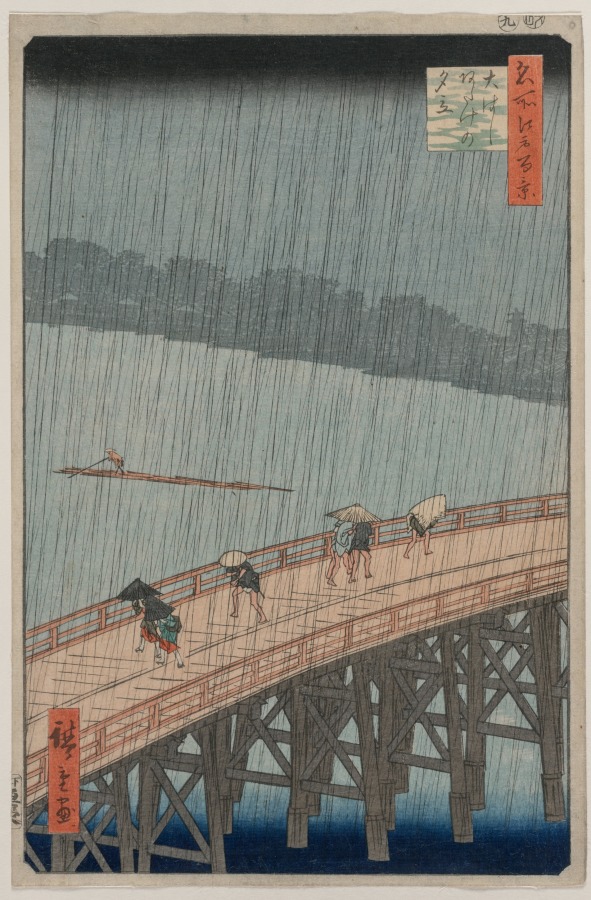
Slanting lines, hunched bodies, and a darkening sky make a burst of rain visible without painting individual drops.
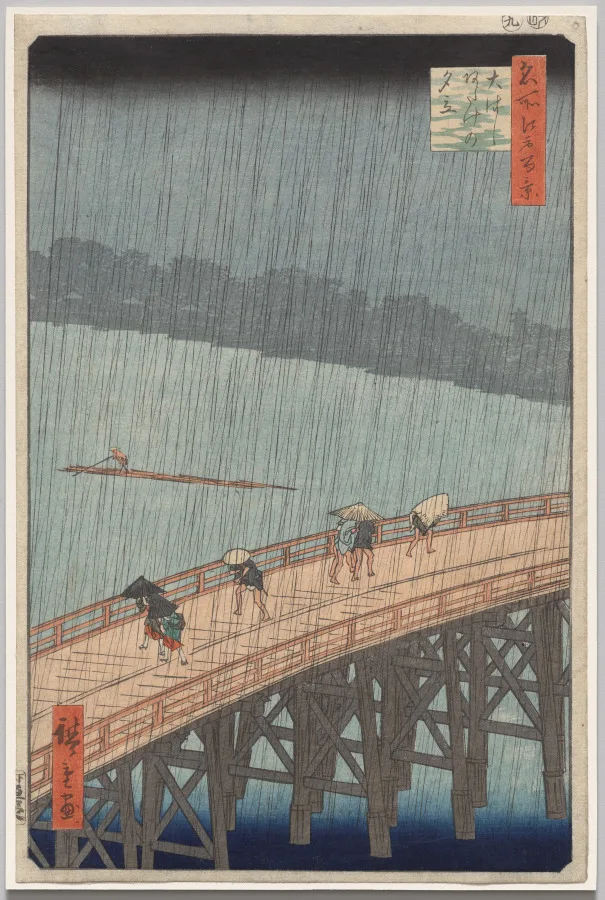
Before naming the place, notice how quickly the scene tells you about the weather. The sky darkens at the top, rain slants across the page, and pedestrians pull coverings over themselves as they cross the bridge. Hiroshige gives a temporary event a strong geometry: the bridge’s broad diagonal meets a field of thinner rain lines, while the far bank stretches almost horizontally beyond them.
The museum identifies this as the rebuilt Great Bridge over the Sumida River in Edo, now Tokyo. The print appeared in 1857, two years after the earthquake and fire of 1855. That historical setting gives the bridge a civic life beyond its usefulness as a compositional device. The figures are small, but their different responses to the shower make the scene recognisably social. Keep the lone figure on the river and the fading shore in view: the rain connects a busy crossing to the larger river landscape rather than isolating the people on a stage.
The bridge’s reconstruction history comes from the museum record, not from a visible inscription explaining it. The rain lines are a graphic convention; they do not document the duration or intensity of a measured storm.