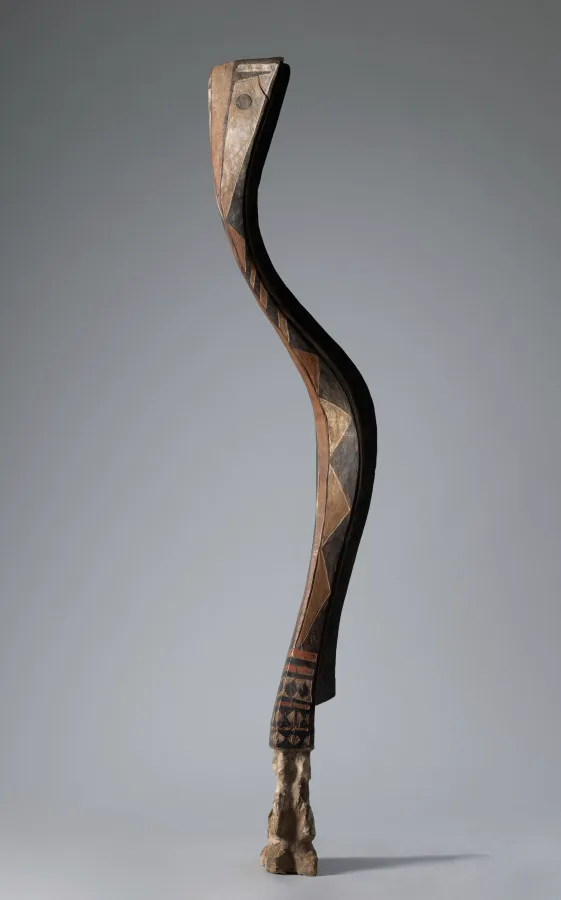
 Africa, West Africa, Guinea, possibly Baga-style maker · late 1800s–early 1900s
Serpent Headdress
Maker unrecorded
Wood (Nauclea pobeguinii) and paint
One form rises through a long wooden curve; the other branches through a chipped stone outline. Both become legible at their edges, where small heads and projections organize larger silhouettes. Their very different scales, materials and documented contexts matter as much as the visual comparison.
Africa, West Africa, Guinea, possibly Baga-style maker · late 1800s–early 1900sMaker unrecorded
Wood (Nauclea pobeguinii) and paint
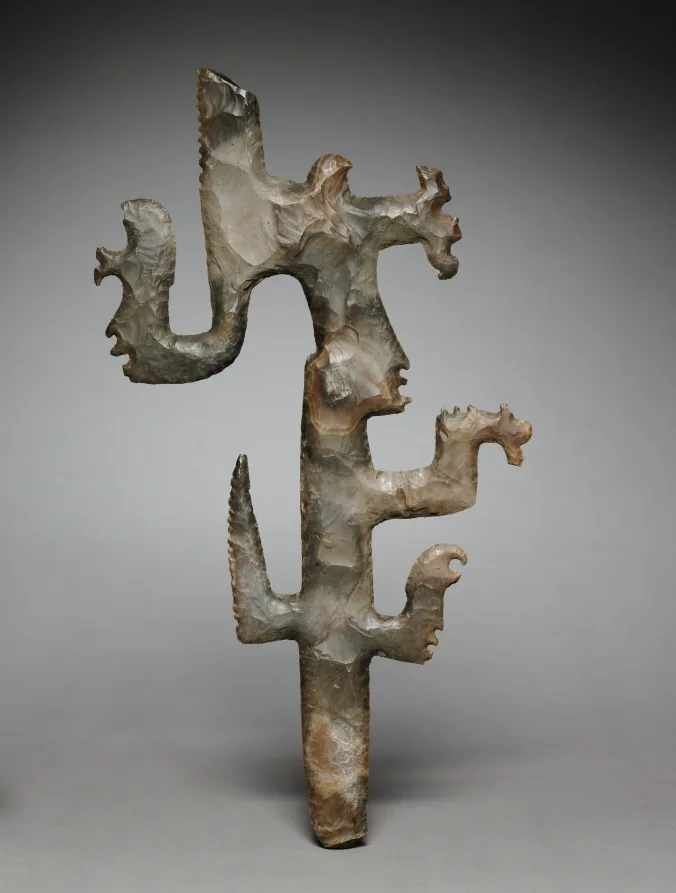 Guatemala, Quirigua, Maya style (250-900) · 600–900
Maker unrecorded
chipped flint
The headdress’s small eye helps establish a head at the top of the tall form. The flint’s central profile presents a nose and lips, with an attribute supporting the museum’s identification of K’awil. Recognition begins with a visible feature but requires different contextual evidence in each work.
The serpent’s body bends outward and inward in one strong continuous curve. Deep notches separate smaller profiles from the flint’s central body. Both organize the surrounding empty space, through a long bend in wood and repeated removals from stone.
The headdress’s lower patterned section leads toward its support, connected with wearing it on a framework. The flint’s lower surface carries overlapping flake facets from controlled removal. These quieter details redirect attention from represented beings toward making and physical use.
The headdress’s Baga and Ninkinanka associations are qualified, and this flint’s precise use is unresolved. A shared interest in silhouette does not establish common beliefs or contact.
The comparison of visible choices is our own reading. Follow either artwork page for its full context, uncertainty note and image-rights record.
Silhouettes, attachments and sound expand five performed forms.
Four American works ask us to separate evidence from reconstruction.