Beyond an animal name
Calling something a buffalo, bird or antelope can help us begin looking, but it can also stop us too soon. These works combine animal references with human action, composite beings and added materials. Each belongs to a particular history of performance or ceremony. Follow the features that an animal name alone cannot adequately explain.
Begin the journey ↓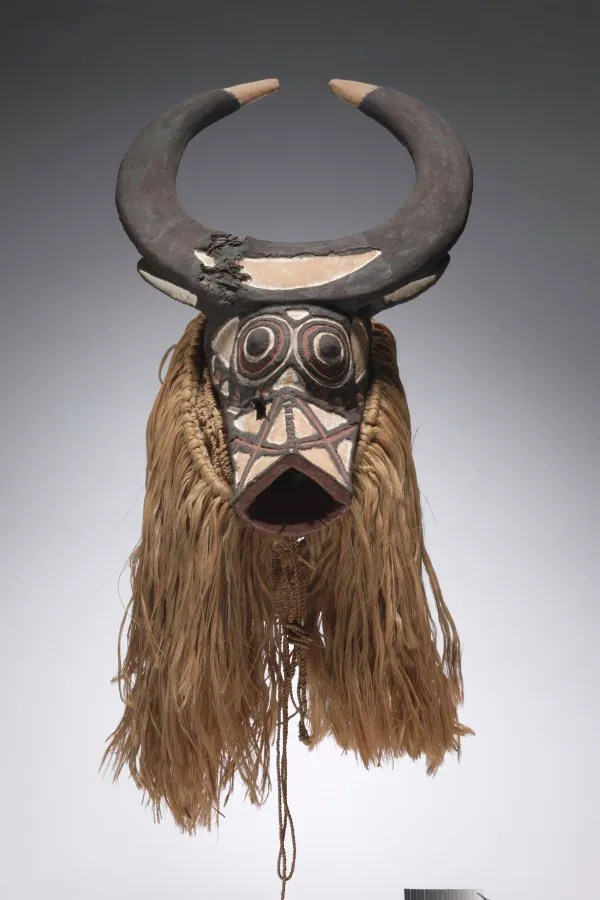
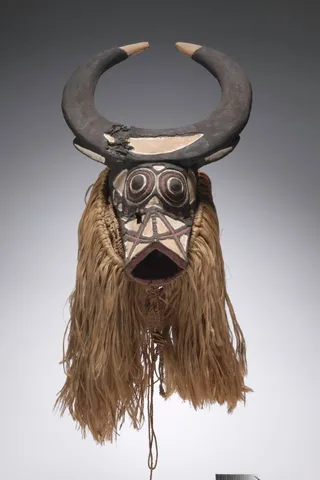
Horns need a wearer
The two sweeping horns establish a buffalo-like outline above circular eyes and a projecting muzzle. The museum’s cultural attribution remains qualified. The plant fibres below remind us that the carved head was part of a larger masquerade appearance rather than a complete self-sufficient animal sculpture.
Carry this question: How do the horns and fibres make the small central face seem larger?
Open the artwork ↗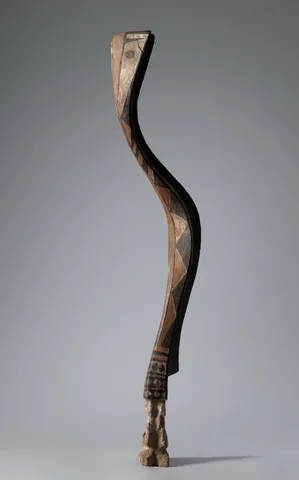
A serpent stretched upward
A long curving body rises above the lower attachment area. The museum tentatively connects this headdress with Baga traditions and the being Ninkinanka. Keep that attribution visible as a qualification while noticing how the tall silhouette would transform the scale of a person beneath it.
Carry this question: Where does the body change the direction of its curve?
Open the artwork ↗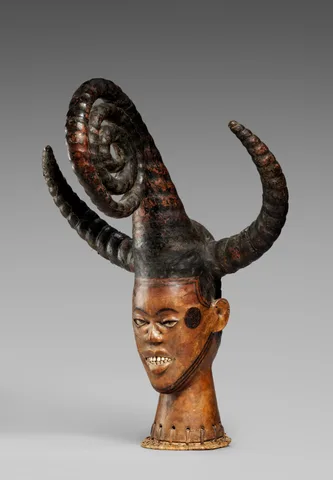
Hair becomes an architectural shape
Large coiling forms rise around the head like an expanded hairstyle. Skin covers the wooden structure, and other materials contribute to the face. The museum proposes a possible connection with the women’s Ekpa society; its particular use should not be treated as conclusively established.
Carry this question: Which part of the outline extends farthest beyond the face?
Open the artwork ↗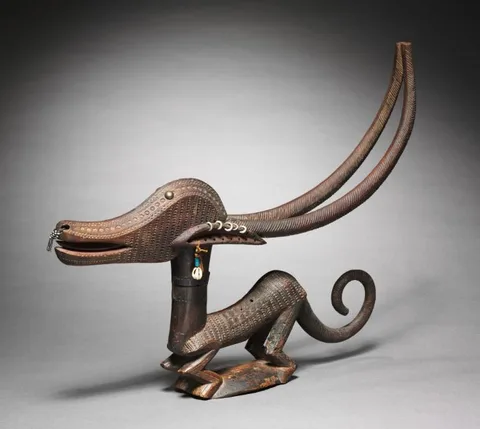
A composite agricultural being
Long horns dominate a small head with an elongated muzzle, while the body and curled tail add other forms. The museum identifies a female Chi Wara agricultural spirit combining several animal references. Shell and bead ornaments further complicate a reading as an ordinary antelope.
Carry this question: Which visible features resist naming a single natural animal?
Open the artwork ↗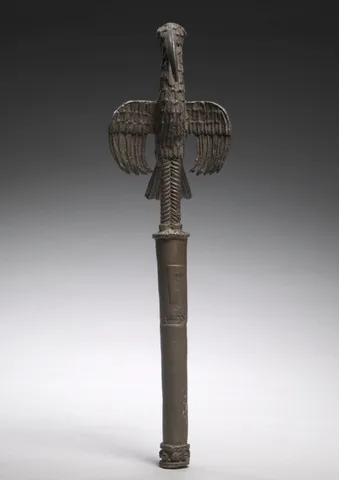
A bird that also sounds
The bird stands above a long cylindrical section. This Benin object was an idiophone, sounded by striking its own material, and relates to a narrative of royal victory. The handle directs attention from the depicted bird toward the actions and sound absent from the photograph.
Carry this question: How does the lower section change your understanding of the object’s use?
Open the artwork ↗Look at a pair more closely
- Silhouettes within silhouettes
A serpent headdress and a Maya eccentric flint demand attention to the edge.
Read with the sources
Historical context follows the individual museum records linked on each artwork page. These routes make original comparisons of visible form; resemblance alone is not evidence of shared meaning or direct influence.