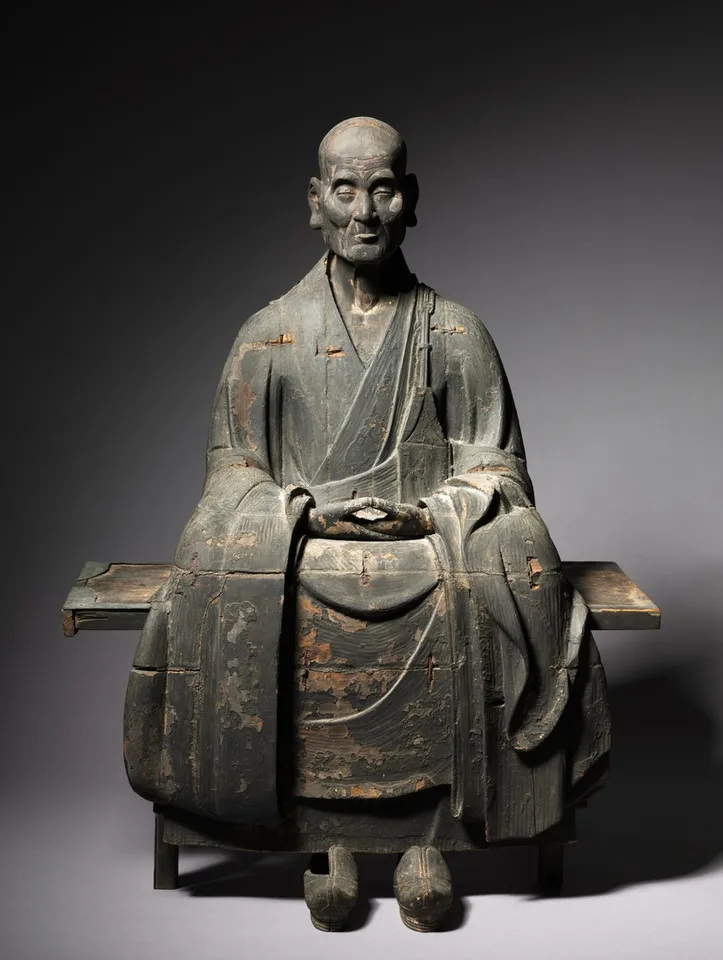
 Japan, Kamakura period (1185–1333) · c. 1295–1315
Portrait of Hottō Enmyō Kokushi
Maker unrecorded
Hinoki cypress wood with lacquer, metal staples and fittings
These sculptures honour named Buddhist teachers, yet their visual strategies differ. One concentrates realism in a particular face above broad robes; the other situates a teacher on a lotus and lion throne. Compare how personal identity and religious authority share the image.
Japan, Kamakura period (1185–1333) · c. 1295–1315Maker unrecorded
Hinoki cypress wood with lacquer, metal staples and fittings
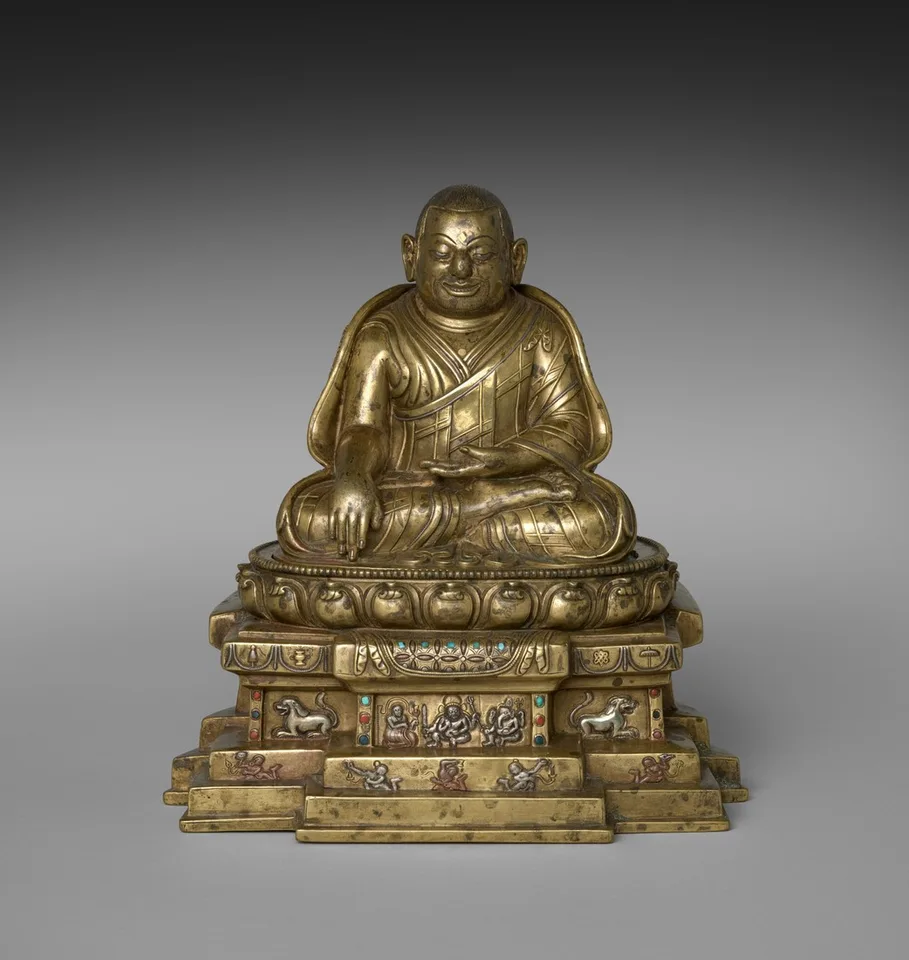 Central Tibet · 1200s
Maker unrecorded
gilt bronze with gold, silver, copper, turquoise, lapis, and coral inlay
Kakushin’s strongly modelled face contrasts with the simplified robe. Phagmo Drupa appears as a robed teacher within a more elaborate sacred support. The museum identifications establish two historical subjects rather than a generic type of seated monk.
Kakushin’s hands meet quietly at the centre. Phagmo Drupa’s differing hand positions carry a museum-supported connection between meditation and enlightenment. Similar stillness does not require identical gestures or a shared interpretation of private mental state.
Broad robe folds focus attention upward in the Japanese portrait. A lotus and lion throne lend the Tibetan teacher conventions associated with Buddha images. Each constructs authority through a different distribution of detail around the seated body.
These portraits belong to distinct Japanese and Tibetan settings. The comparison does not equate their institutions, teachings or notions of likeness, and neither face gives direct access to private character.
The comparison of visible choices is our own reading. Follow either artwork page for its full context, uncertainty note and image-rights record.
Six different relationships between figure, story, writing and spiritual authority.
People represented through authority, action, costume and selective detail.