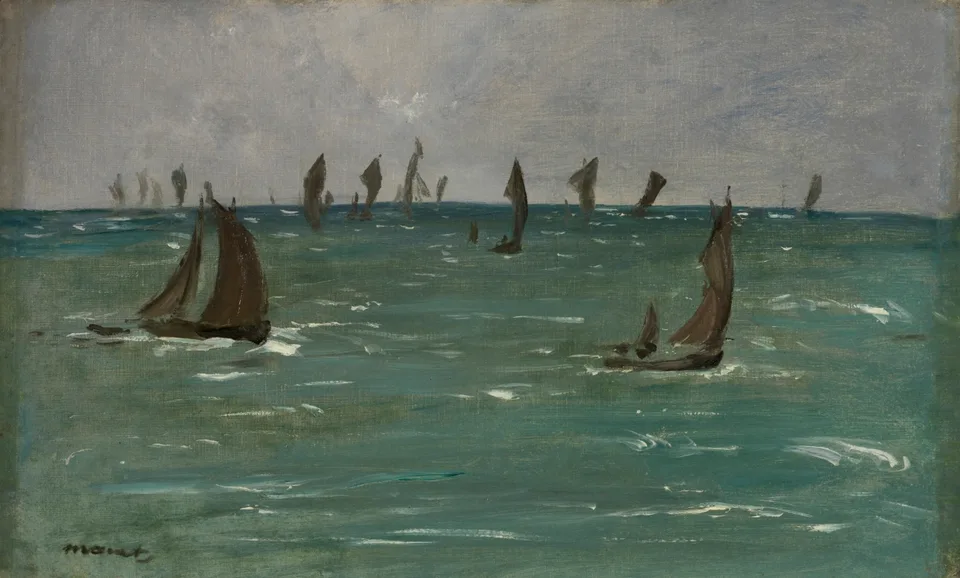
 France · 1873
Boats at Berck-sur-Mer
Édouard Manet (French, 1832–1883)
oil on fabric
Boats give one seascape a chain of scale references, while rock and surf carry the other almost entirely. Compare how marks turn into moving water and how a stable shape makes that movement easier to recognize.
France · 1873Édouard Manet (French, 1832–1883)
oil on fabric
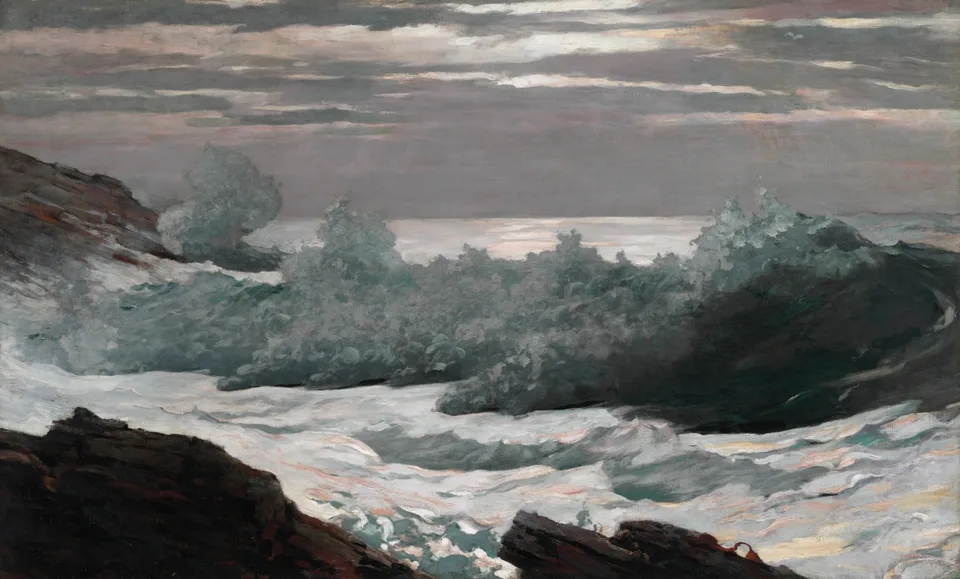 United States · 1900–1903
Winslow Homer (American, 1836–1910)
oil on canvas
Manet’s large foreground sail and hull provide a measure for the smaller vessels beyond. Homer’s angular rocks anchor the lower edge against churning foam. Both offer a stable reference, but one makes human activity central while the other concentrates on physical forces.
Manet’s white dashes scatter across broad green water. Homer gathers dark water into a large continuous wave before breaking it into pale spray. The contrast is not simply calm versus violent: each picture organizes different kinds and sizes of marks into a readable surface.
Manet’s tiny sails stretch near the horizon and imply a sea extending beyond the frame. Homer places a luminous band beyond the breaking waves. Both separate a nearer zone of activity from a more distant expanse, giving depth to scenes with relatively few solid landmarks.
These are different coasts and working histories. Homer’s documented multi-session process especially cautions against equating a momentary-looking wave with a painting made in one rapid sitting.
The comparison of visible choices is our own reading. Follow either artwork page for its full context, uncertainty note and image-rights record.
Four ways of deciding what a landscape asks us to notice.
Distance emerges through marks, scale, edges and degrees of finish.