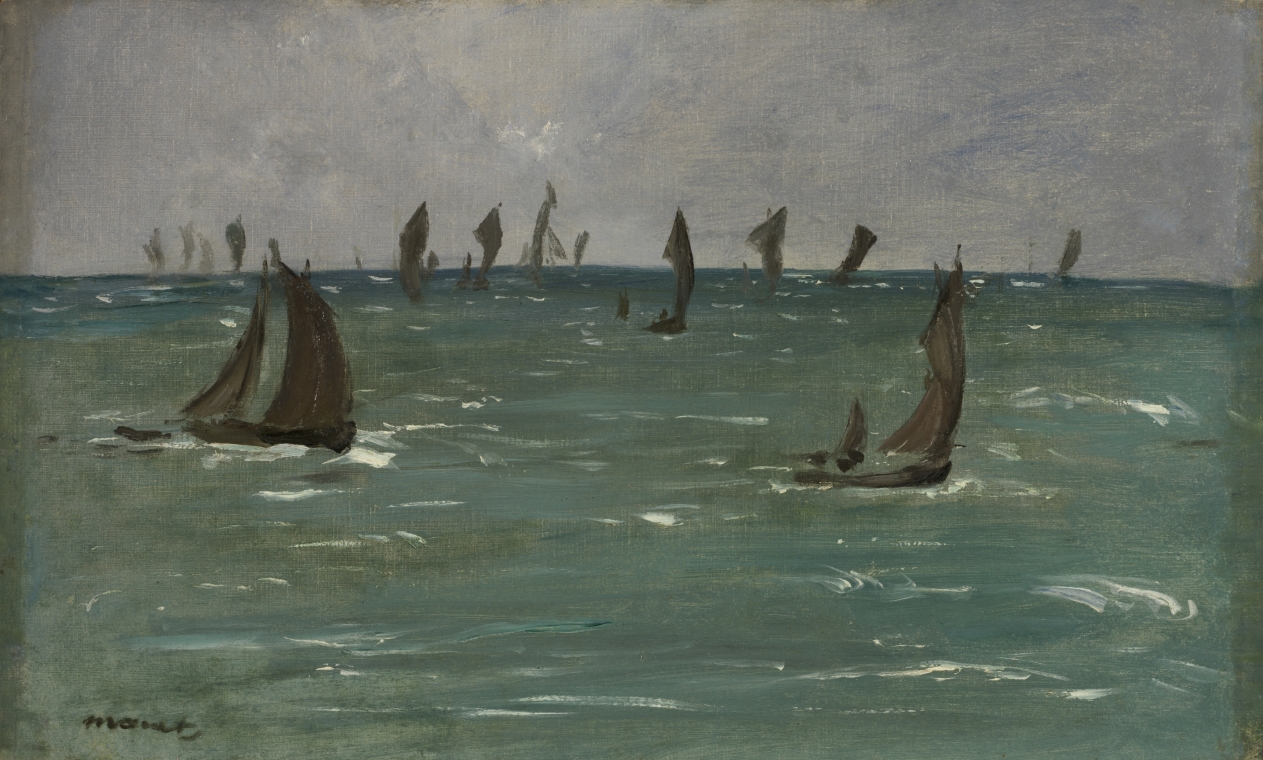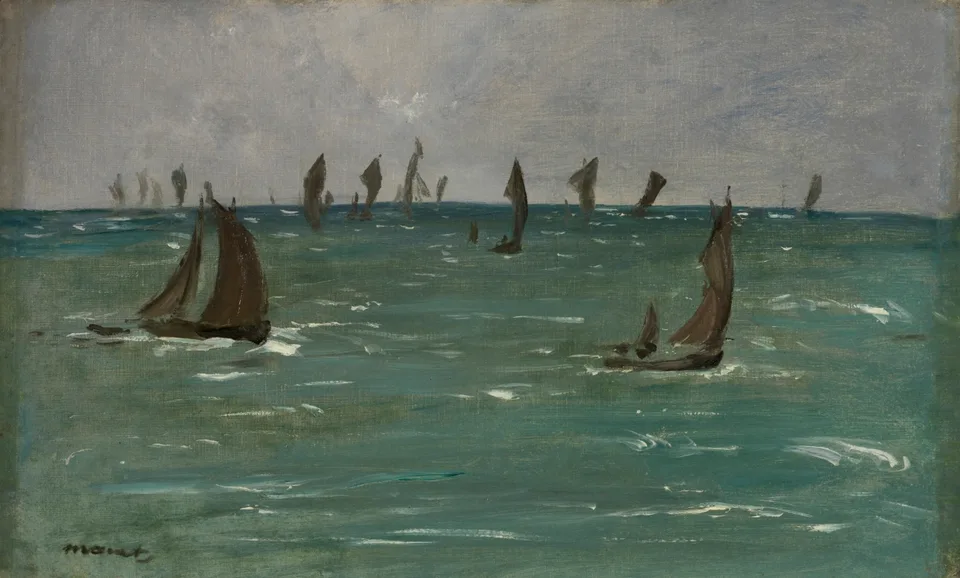
Two near boats and a scatter of distant sails turn a small canvas into an expansive field of wind and water.
The sails give the open water a rhythm. Two nearby boats appear large enough to distinguish their hulls, while smaller dark shapes collect near the horizon. Between them, white strokes skip across blue-green paint. Manet describes movement through these abbreviated contrasts rather than through a detailed inventory of rigging or waves. The broad gray sky leaves the sea’s activity concentrated in the lower portion.
The museum places the painting during Manet’s stay at Berck-sur-Mer in 1873. His connection with the sea included an adolescent voyage as an apprentice on a training ship, but biography does not explain every brushstroke. Here, the useful evidence lies in differences of size, spacing, and color. The museum notes a slight curve in the horizon that contributes to an impression of extensive space. Follow the sails from foreground to distance: a limited set of marks builds a setting that seems to continue beyond the canvas.
The boats are rapidly abbreviated, so their exact identities or destinations cannot be established from this image. The slight horizon curve is a compositional effect, not a navigational measurement or a scientifically precise depiction of the earth.