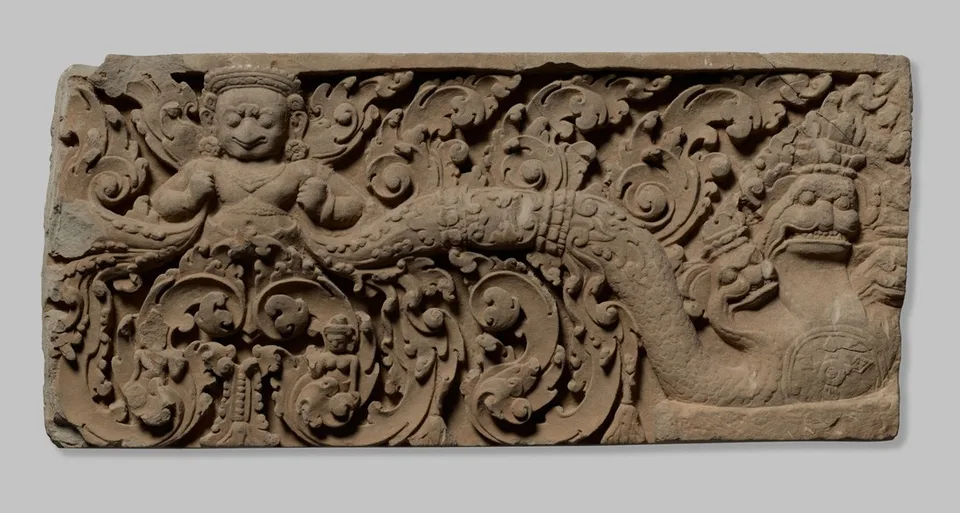
 Cambodia · 875–925
Lintel with Garuda
Unknown sculptor
sandstone
Both works keep the boundary between plant and creature active, but their stories and settings differ. A stone lintel belongs to temple architecture; a drawing attributed to Sahkulu stages a fantastical pursuit around a small inscribed object. Follow each transformation before comparing meanings.
Cambodia · 875–925Unknown sculptor
sandstone
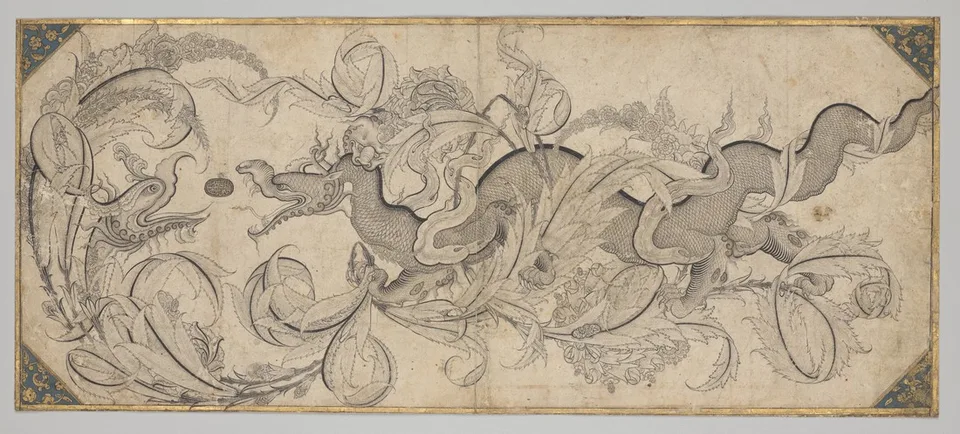 Ottoman Turkey, Istanbul · mid-1500s
Attributed to Sahkulu
Ink, gum tempera, and gold on paper
Garuda’s human-eagle form emerges among foliate wings and stems. In the drawing, a lion’s head grows from flowering branches and bites the dragon. Recognition depends on watching where ornament becomes anatomy rather than treating every curl as background.
The lintel’s vegetation resolves into cobra heads at the edges. The drawing’s scaled dragon repeatedly disappears beneath pointed leaves. These different transitions keep the eye active, asking it to separate connected forms that share curves and textures.
A tiny female figure occupies the lintel’s growth, while a small inscribed pearl-like seal becomes the drawing’s object of pursuit. Both reward slow looking, but the museum supplies different religious and narrative contexts for these details.
Shared visual transformation does not establish a common religious meaning or direct influence. The Khmer architectural setting and the attributed Ottoman drawing must remain distinct in chronology, function and interpretation.
The comparison of visible choices is our own reading. Follow either artwork page for its full context, uncertainty note and image-rights record.
Weapons, dance, thresholds and ceremonial transport.
Animal vessels, courtly sport and deliberately unstable forms.