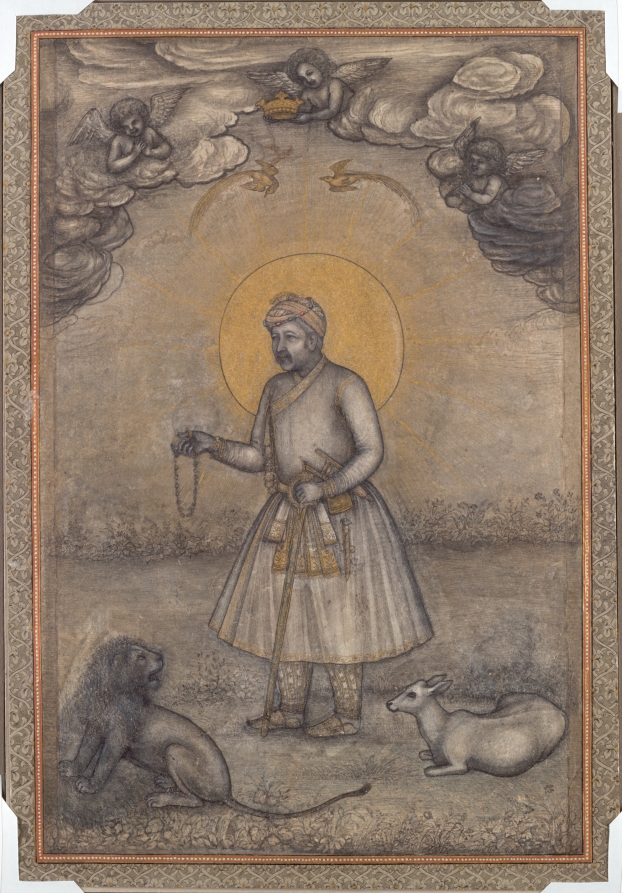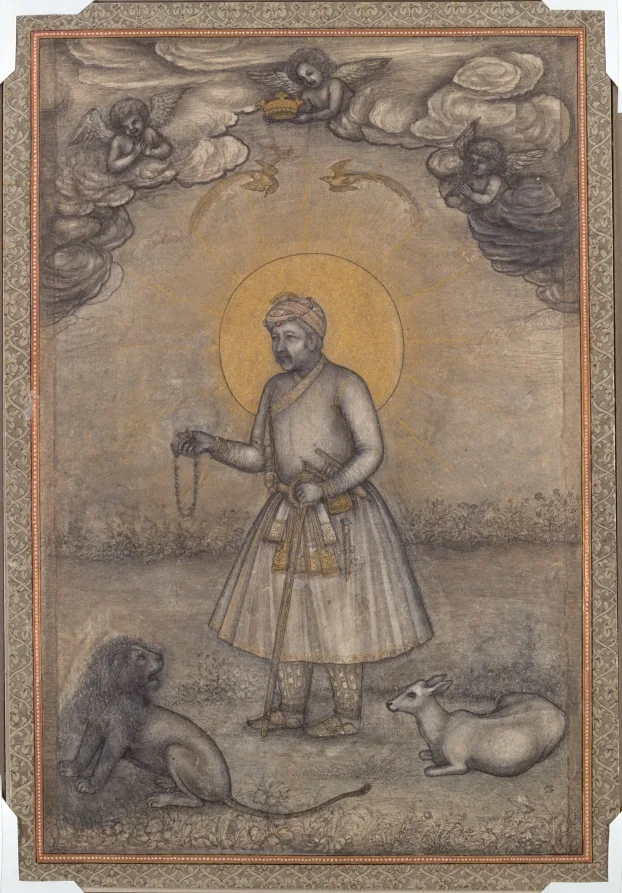
A lion beside a resting calf makes this imperial portrait an argument about rule as well as a likeness.
The ruler’s face is carefully aged, yet the world around him is deliberately extraordinary. A gold halo lights the head, winged figures occupy the clouds, and a lion rests close to a young cow. The museum identifies the subject as Akbar and the picture as a posthumous portrait made for his grandson Shah Jahan. It presents ancestral authority through an ideal arrangement rather than recording an observed meeting of emperor and animals.
The work is attributed to Govardhan, with the sensitive modelling of the face forming part of the museum’s case. Light colour and gold sit within a largely drawn composition. The museum also records later interventions: stronger outlines, copying holes, and the replacement of an orb with the necklace now held by Akbar. Look closely without assuming every mark belongs to one moment of creation. This image has both a represented history of imperial lineage and a material history of revision and reuse.
The attribution to Govardhan remains qualified, and the portrait was made after Akbar’s death. The animals express an ideal of peaceful rule; their arrangement is not evidence of an actual encounter.