A woman teaching young scholars becomes a birthday tribute, joining a historical exemplar to the artist’s own family.
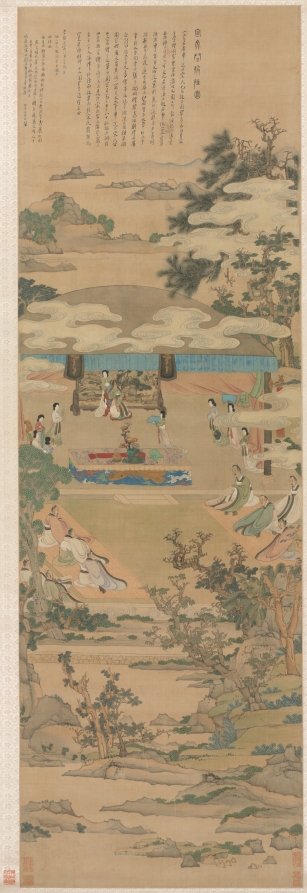
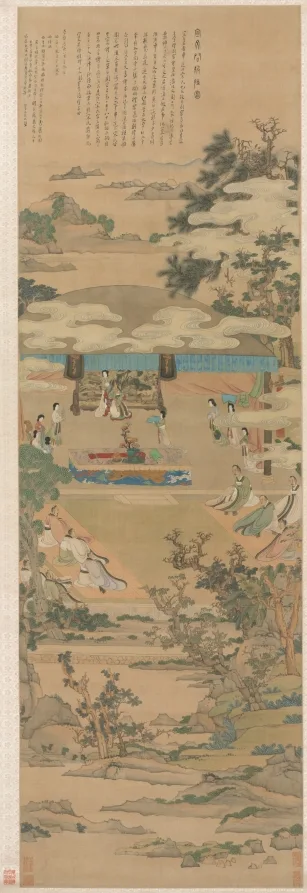
The teaching scene is nested inside an expansive setting of rocks, trees, and clouds. Locate the seated older woman in the pavilion, then follow the younger figures around her. Their grouping makes instruction a social event, while the fine outlines and carefully controlled clothing give the figures a deliberately antique appearance. The museum identifies the subject as Lady Xuanwen teaching young scholars the Confucian classics.
Chen Hongshou made the painting for his aunt’s sixtieth birthday, comparing her virtues with those of this historical exemplar. That occasion changes how the story works: it is also a family tribute and a statement about female learning. The long inscription is therefore important evidence, not simply spare decoration above the scene. The museum notes the fine even “iron-wire” outlines, elongated faces, mineral colours, and ritual bronzes that contribute to its archaic style. A historical subject can be made to speak to a much later personal relationship.
This is a seventeenth-century interpretation of a historical exemplar and a tribute to the artist’s aunt. It is not an eyewitness record of Lady Xuanwen’s original lessons or a portrait identifying every student.
What turns this historical teaching scene into a personal tribute?
Practise looking at Lady Xuanwen Giving Instruction on the Rites of Zhou →