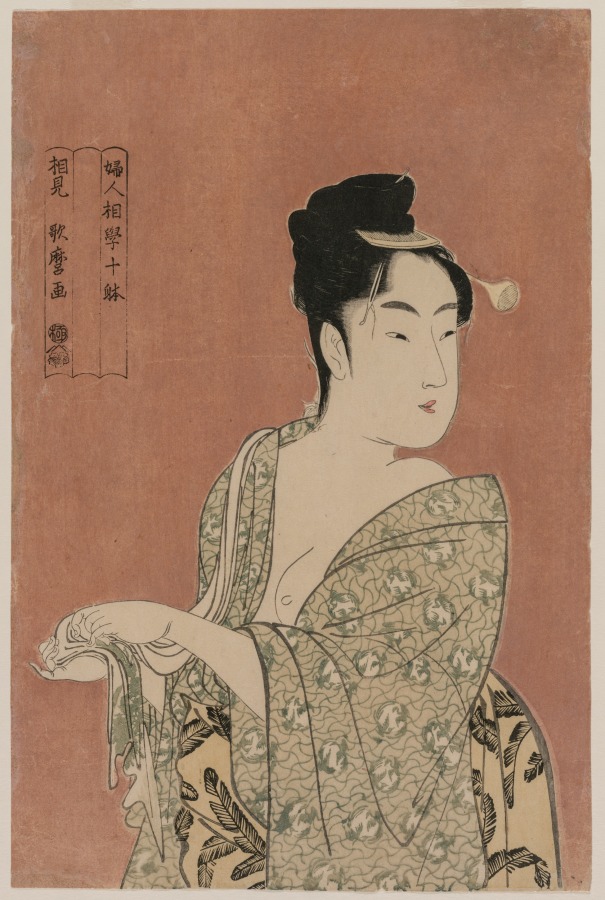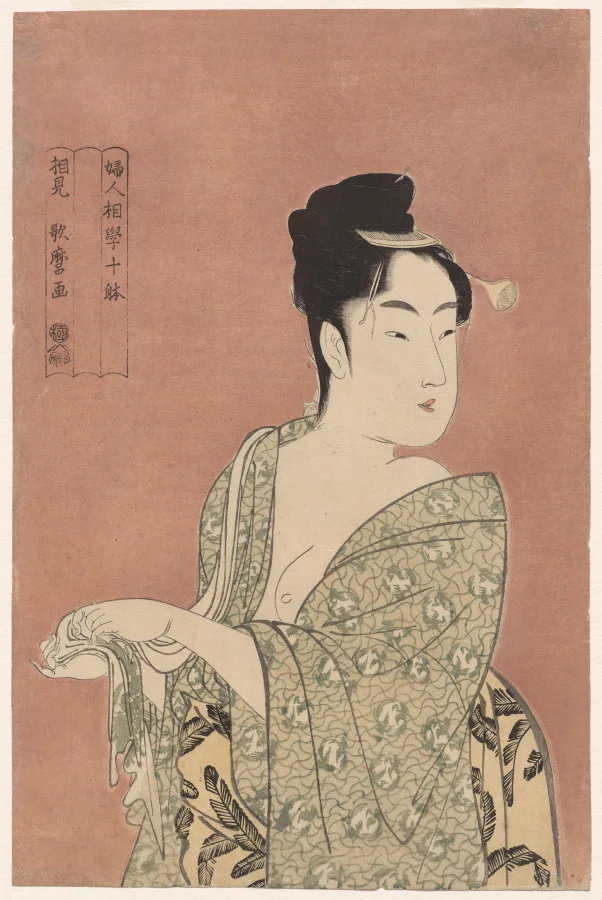
A turning head and patterned robe reveal how a commercial portrait could invite a personality judgement that appearance cannot actually prove.
The close crop gives the turning head, hands, and robe most of the sheet. Fine lines distinguish facial features from the dense pattern on the garment, while the plain pink ground leaves little competing scenery. This is an example of bijinga, a commercial print category often translated as pictures of beautiful people, rather than a documentary record of a named sitter’s private life.
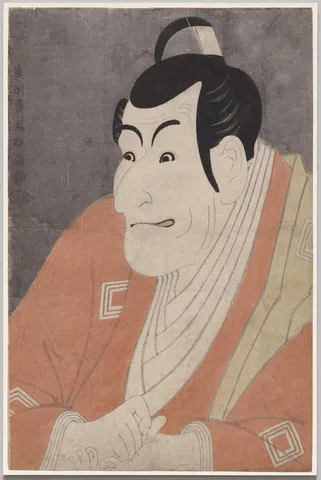
The series invited viewers to compare women and assign personality types from outward appearance. Its title records that historical invitation; the designed pose cannot establish a real person’s character. Here the turning head, loosely arranged robe and plain pink field concentrate attention on selected signs rather than a full biography. The museum notes that only two impressions from this series use pink mica. Compare Sharaku’s actor portrait: its costume crest offers a documented family affiliation, while Utamaro’s title invites a much less verifiable judgement of temperament.
The historical title’s personality label is not endorsed as a valid judgement about a woman’s character. Appearance and clothing cannot establish temperament, and the print does not provide a verified individual biography.
How should we treat the title’s personality label?
Practise looking at The Flirtatious Type, from Ten Types in the Physiognomy of Women →