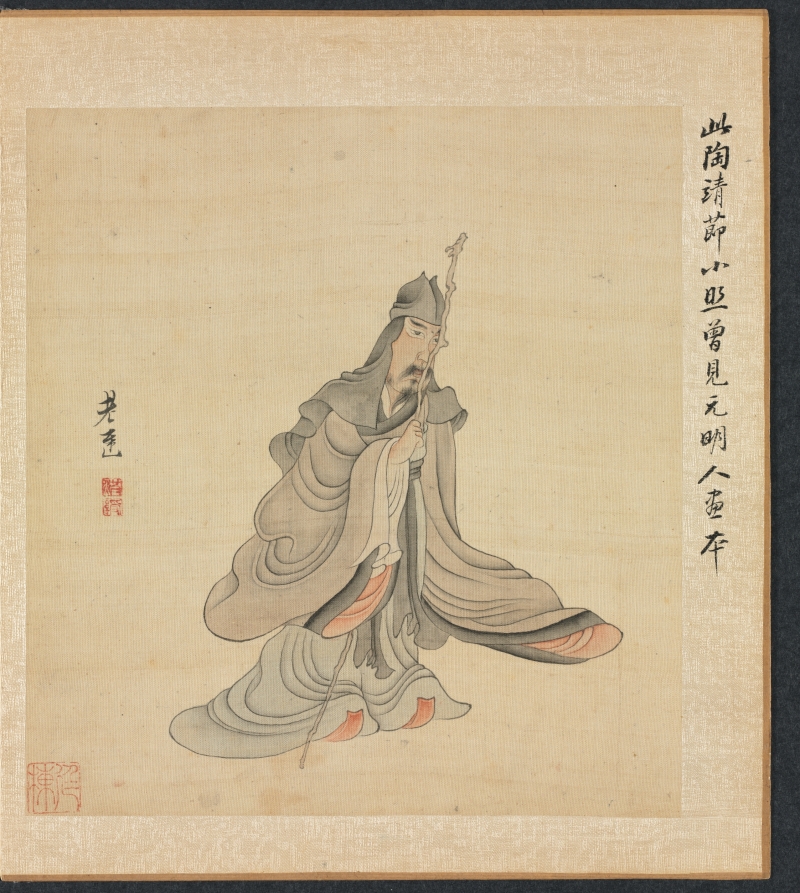
A staff and flowing robe let a later painter imagine a poet whose choice of withdrawal still carried political weight.
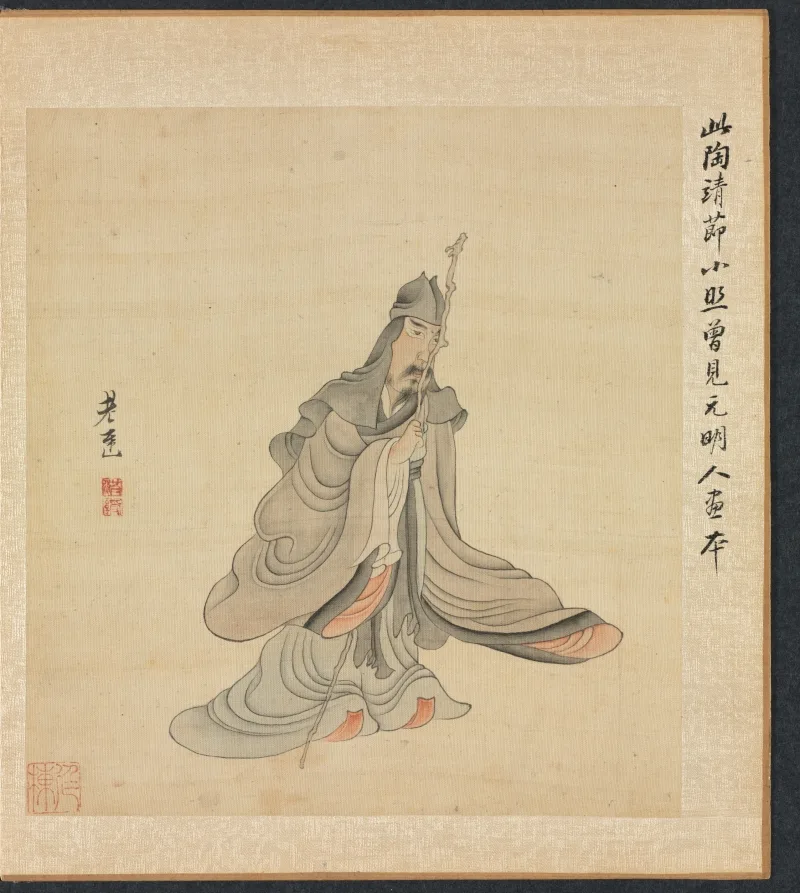
The figure’s robes seem almost larger than the body they contain. Broad curved folds gather at the feet and billow to one side, while a narrow staff gives the composition a firm vertical accent. The museum identifies the man as Tao Yuanming, a poet who left official service to live on his estate and devote himself to poetry, gardening, and wine.
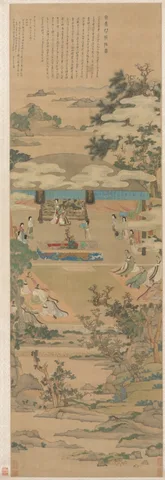
Chen Hongshou painted the image roughly a millennium after Tao’s lifetime, during another age of political upheaval. The museum connects his deliberately archaic style with that historical comparison. This is an imagined portrait that selects a recognisable posture and attribute, not a record of the poet’s physical appearance. The staff relates to accounts of Tao’s ailing foot, although it also becomes a useful visual counterpoint to the robe’s curves. Read it alongside Lady Xuanwen Giving Instruction: the same painter could use figures from the past to address very different relationships and values in his own time.
The image was made long after Tao Yuanming lived and cannot verify his appearance. The staff’s biographical association follows the museum record; its presence does not prove an observed moment from the poet’s life.
Why should this be described as an imagined portrait?
Practise looking at Paintings after Ancient Masters: Portrait of Tao Yuanming →