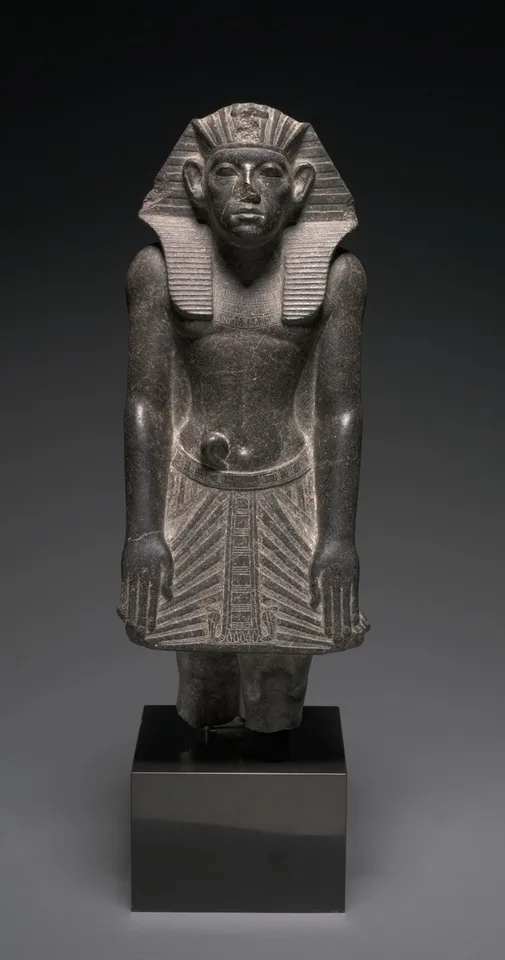
Hands pressed against a pleated kilt make a compact stone figure, while oversized ears give its attentive face a royal meaning.
Although this statue has no identifying inscription, the museum attributes it firmly to Amenemhat III on the basis of his characteristic facial features. Heavy brows, prominent cheekbones and a tightly modeled mouth create an individualized-looking face. The very large ears work differently: the museum explains them as a sign of the ruler’s willingness to hear his people’s prayers. Apparent realism and deliberate symbolic exaggeration therefore coexist within one head.
The body is just as carefully organized. Hands press flat against the kilt, whose diagonal pleats converge on a central panel. The museum relates this compact arrangement to the practical danger of breaking extended stone limbs: a worshipping gesture that might be raised in relief is held close in sculpture. Notice the loop of cloth above the belt, a small asymmetry inside the otherwise frontal design. The surviving statue joins an expressive face, a protective material strategy and a costume rendered through repeated lines.
The king’s identification rests on comparison of features, not an inscription on this statue. Its missing lower legs and modern mount also alter the original standing silhouette.