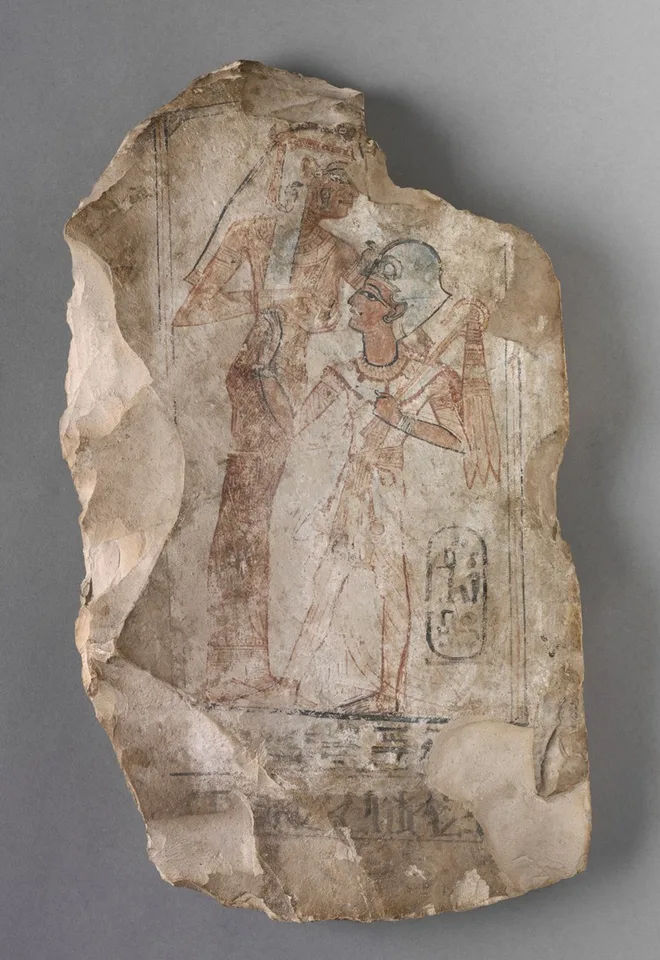
A king appears at a child’s scale beside a much taller goddess, on a limestone flake that preserves an artist’s working surface.
Natural flakes of limestone offered Egyptian artists convenient surfaces for writing and drawing. Such ostraca could support practice, teaching, sketches or nearly finished images; the category does not determine the status of every example. Here inscriptions identify the smaller figure as Ramesses II. Although his proportions are those of an adult, his scale makes him childlike beside a goddess who nurses him. Scale expresses the relationship more decisively than biological age.
The goddess’s tall outline dominates the left side, while the king’s blue crown and raised face draw attention toward their encounter. Long wing shapes form part of her garment. The museum does not name her securely: several protective mother or sky goddesses could fit the image. The irregular stone boundary is equally important. The scene survives on a broken, everyday drawing support, bringing a royal religious subject into close contact with an artist’s hand and the practical materials of work near Thebes.
The goddess cannot be securely named, and the ostracon’s purpose as practice, instruction or a finished small image is uncertain. The king’s small size does not depict his actual age.
Which visible device makes the adult king appear dependent on the goddess?
Practise looking at Ostracon: Ramesses II Suckled by a Goddess →