Bodies and roles in Egyptian images
These five Egyptian works represent bodies through deliberate choices. An enlarged ear can express royal attention, a smaller king can take a child’s role, and a carried jar can suggest service. Follow those choices without assuming that every image is a literal portrait. Fragmentary survival and uncertain identifications remain part of what each work can tell us.
Begin the journey ↓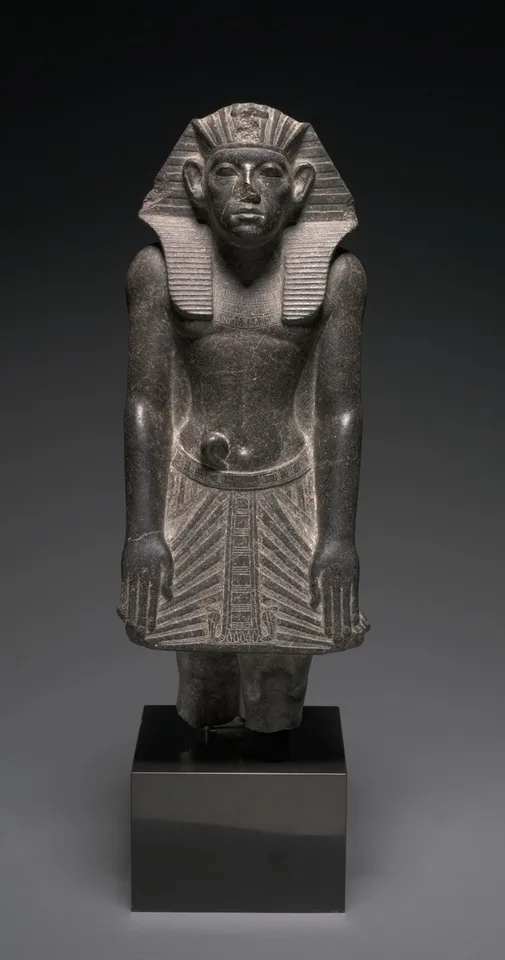
Ears for royal attention
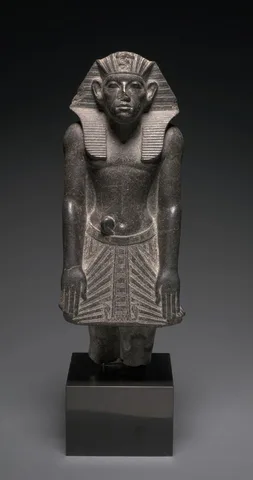
The projecting ears are more conspicuous than naturalistic scale alone would require. The museum interprets them as readiness to hear prayers, while the king’s identification rests on comparison rather than an inscription on this statue.
Carry this question: How do the ears change the silhouette of the head?
Open the artwork ↗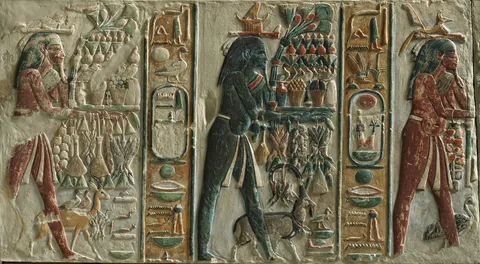
A body carrying abundance
The heaped tray makes an offering visible in front of the figure. The museum identifies personifications of provinces bringing produce, so the carried objects help turn a geographic idea into a procession.
Carry this question: How much space does the tray occupy beside the body?
Open the artwork ↗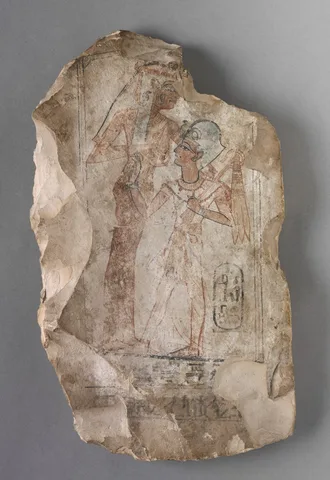
A king at a smaller scale
The king stands much smaller than the goddess despite his adult proportions. The museum connects that scale with a nursing relationship, reminding us that relative size can express a role rather than age.
Carry this question: Which proportions keep the smaller figure recognizably adult?
Open the artwork ↗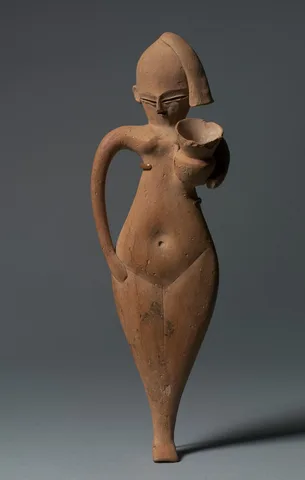
A jar defines an action
The open vessel against the shoulder gives the small clay figure a task. Its exact function remains uncertain, so a service role can be considered without inventing a known owner or a specific tomb.
Carry this question: What changes if you imagine the figure without its jar?
Open the artwork ↗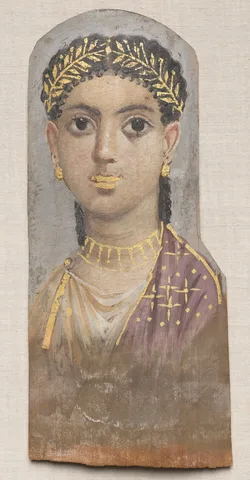
Gold beyond ordinary likeness
The golden lips interrupt the shaded face. The museum proposes a connection with transformation after death, leaving that interpretation qualified. A funerary image can combine observed appearance with a different kind of aspiration.
Carry this question: Where does gold differ most strongly from the painted skin?
Open the artwork ↗Read with the sources
Historical context follows the individual museum records linked on each artwork page. These routes make original comparisons of visible form; resemblance alone is not evidence of shared meaning or direct influence.