Read the
Picture
An open collection
Egypt, Roman Empire, late Tiberian · Painting

Funerary Portrait of a Young Girl

Maker unrecorded · c. 25–37 CE

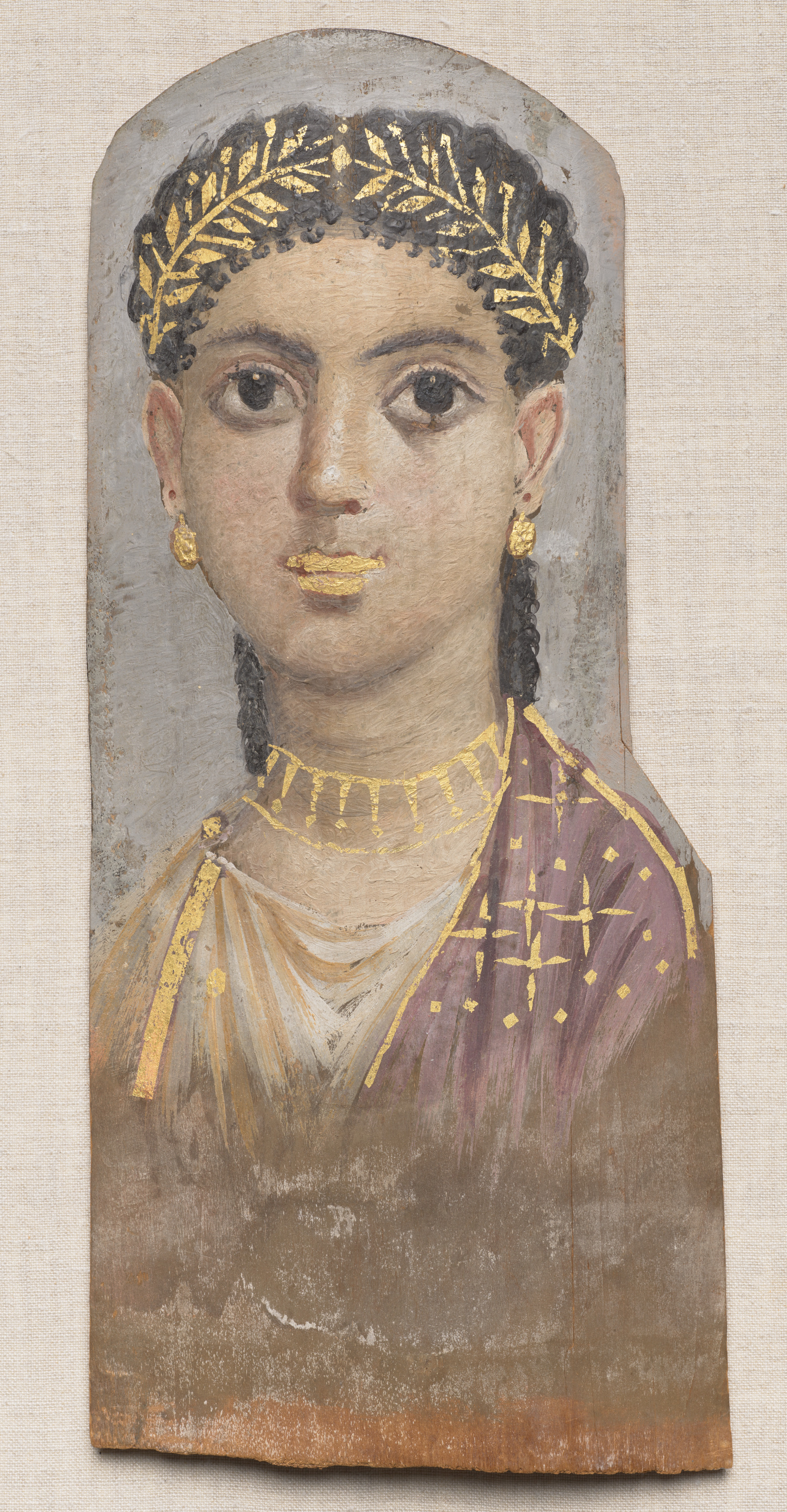
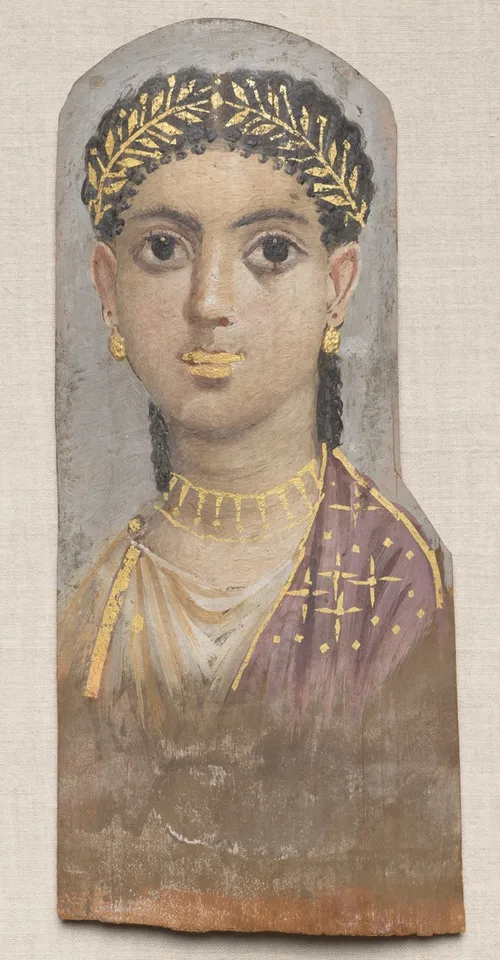
A narrow wooden panel portrays a young woman facing slightly left while looking toward the viewer. Dark curls frame her forehead beneath a gold leafy wreath. Her lips, earrings, necklace and parts of her purple garment are gilded. The rounded upper panel and worn lower area remain visible around the painted bust.
100%

Drag to move · Pinch or +/− to zoom · Arrow keys to pan · 0 to reset

The Cleveland Museum of Art · 1971.137 · Image: CC0Museum image ↗
A little context

Golden lips interrupt a carefully shaded face, asking us to distinguish a person’s appearance from an image prepared for transformation after death.

This portrait comes from Egypt under Roman rule, where Egyptian burial traditions continued alongside Greco-Roman dress and pictorial conventions. The museum explains that the sitter or her family chose mummification, providing a physical resting place for the deceased’s soul. The painting’s clothing and hairstyle also express contemporary Hellenic Egyptian identity. These choices belong to overlapping practices rather than two sealed cultures represented by separate halves of the image.

The face is shaded to suggest volume, yet the gold lips interrupt that bodily illusion. Gold also marks wreath, jewellery and garment details, binding them into a bright network across the portrait. The museum proposes that gilding the lips may have signified transformation into an effective spirit, an akh. That interpretation remains a possibility, not a visible fact. Begin with the material contrast between modeled skin and reflective gold, then consider how an image could address both a remembered person and an anticipated afterlife.

A careful reading

The sitter’s name is unknown, and the spiritual meaning of the golden lips is proposed rather than certain. The painted face should not be treated as a transparent record of her appearance.
Try your eye

Which detail most clearly interrupts the face’s naturalistic colour modeling?

Where this reading begins

  • Funerary Portrait of a Young Girl: collection record — The Cleveland Museum of Art. Identification, qualified cultural and maker attribution, materials, object-specific historical context, provenance and stated uncertainties; photograph independently inspected for visual observations. Museum record updated 2026-07-25; accessed 2026-11-14.

Our observations describe the supplied museum photograph. Historical identifications and context follow the cited collection record; interpretive limits are stated above. This is an independent guide, not a museum endorsement.

Image rights & attribution

Funerary Portrait of a Young Girl, c. 25–37 CE. Egypt, Roman Empire, late Tiberian. Encaustic on linden wood; overall: 39.4 x 17.4 cm (15 1/2 x 6 7/8 in.). The Cleveland Museum of Art, John L. Severance Fund, 1971.137

Individual API record marked CC0; checked 2026-11-14. CC0 1.0 dedication. Record date: 2026-07-25 11:42:21.065000. Museum print JPEG preserved unchanged in local originals; overview JPEG resized and recompressed from that same full frame; responsive WebP and zoom derivatives resized and recompressed; numbered annotation overlay separate from image.