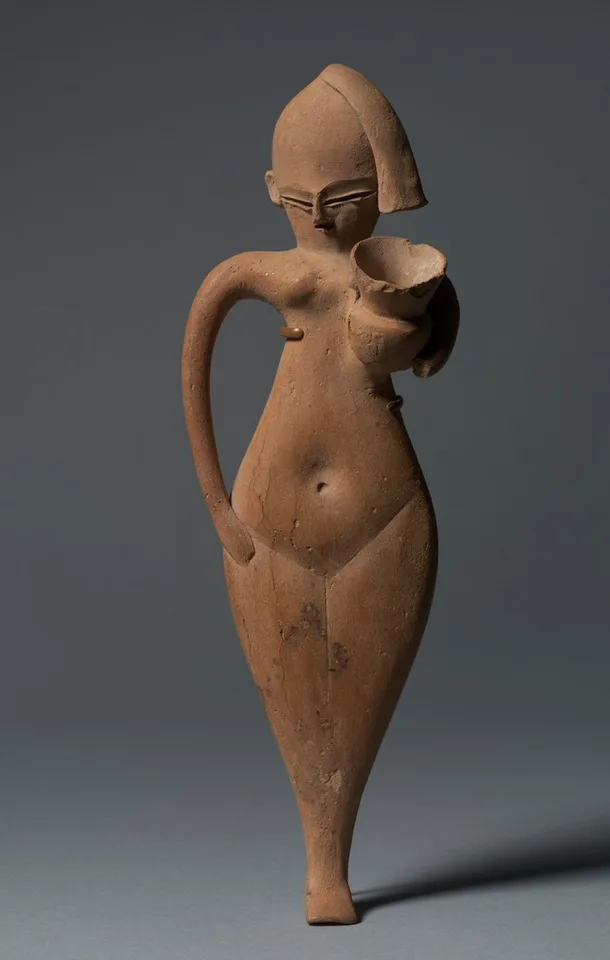
A small jar held against one shoulder gives this hand-modeled clay figure a task, while its precise purpose remains unresolved.
The museum identifies this young figure as a serving girl carrying a jar. In Egyptian pictorial conventions, her nudity and sidelock indicate youth. She belongs to a small group of hand-modeled terracottas whose shared features suggest production in one workshop. Narrow eyes, pronounced hips, triangular legs and a navel pressed into the clay make the figure distinctive without requiring a naturalistic rendering of every part of the body.
The jar changes the balance of the image. One arm forms a close support beneath it, while the other makes a long open curve down the side. The vessel’s mouth also introduces a real cavity into a mostly solid figure. The terracotta was originally painted, so its present uniform colour does not reproduce the original effect. Its exact function is unknown. The museum reports a suggestion that such figures served the dead magically in tombs, but that proposal should not become a certain biography for this particular object.
The figurine’s function is unknown; a funerary service role is a suggestion. Its original paint is largely absent, and the workshop connection rests on similarities among a small group.