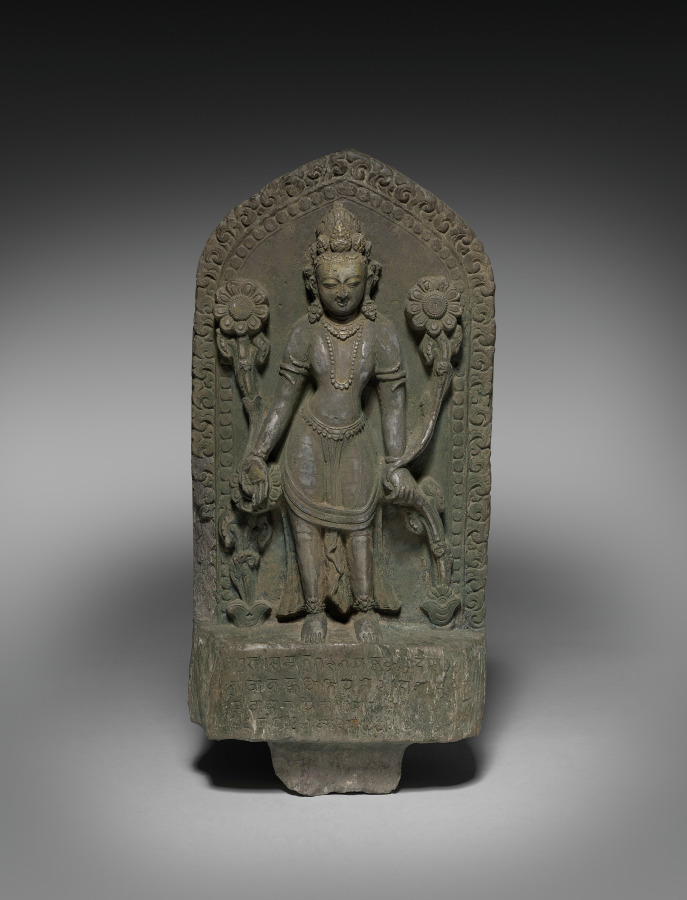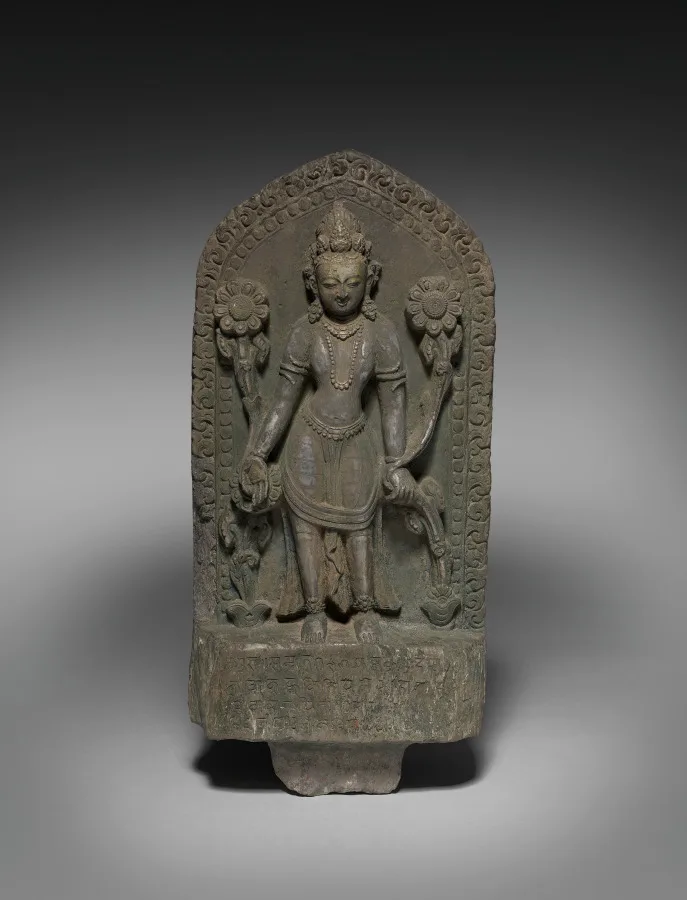
Two flowering stems frame a standing bodhisattva, while a tiny figure in the crown gives another clue to identity.
The paired blossoms are easy to see before the smaller details. Each lotus rises beside the figure, making a symmetrical frame within the curved stele. The museum identifies the standing bodhisattva as Avalokiteshvara Padmapani, the Lotus Bearer. The flowers are therefore identifying attributes in this context, not simply plants used to fill empty space.
Look next at the crown, where a tiny seated Buddha appears. The museum identifies him as Amitabha, adding another relationship to the larger figure’s identity. The record also describes an antelope skin over the shoulder, a connection with ascetic imagery that may be less clear at a small screen scale. This Nepalese stele belongs to a long regional history of Padmapani devotion, but that does not mean every Avalokiteshvara image takes the same form. Compare Seated Guanyin from China: a related bodhisattva can be presented through markedly different posture, materials, clothing, and surrounding setting.
The museum identifies the crown figure and shoulder attribute. Some small carved details are difficult to distinguish at overview scale, and similarities with Guanyin do not make all regional forms or devotional histories identical.
Why are the two lotuses more than background decoration in this work?
Practise looking at Bodhisattva of Compassion, Avalokiteshvara Padmapani →