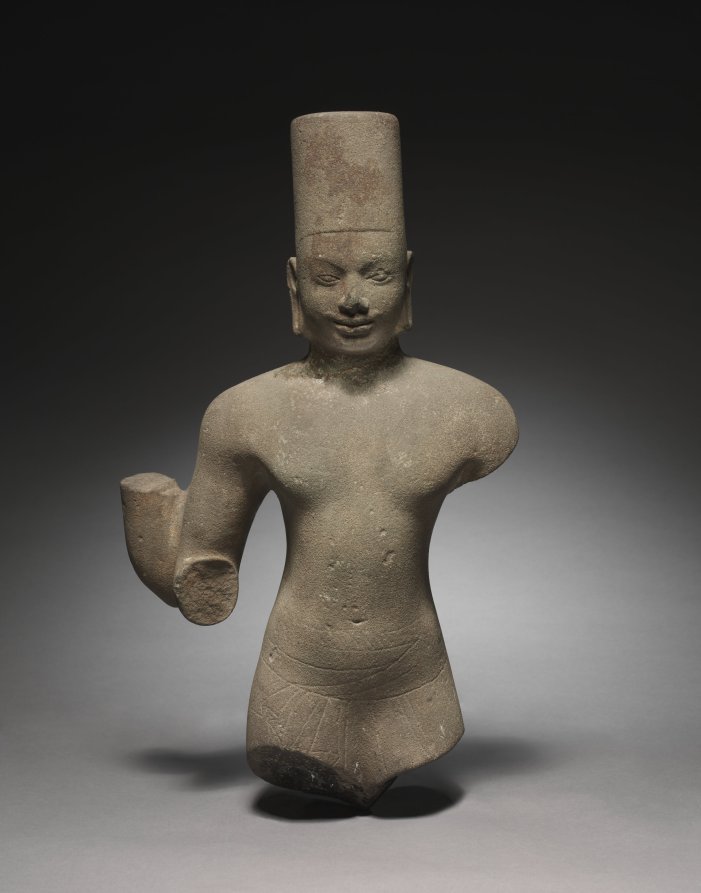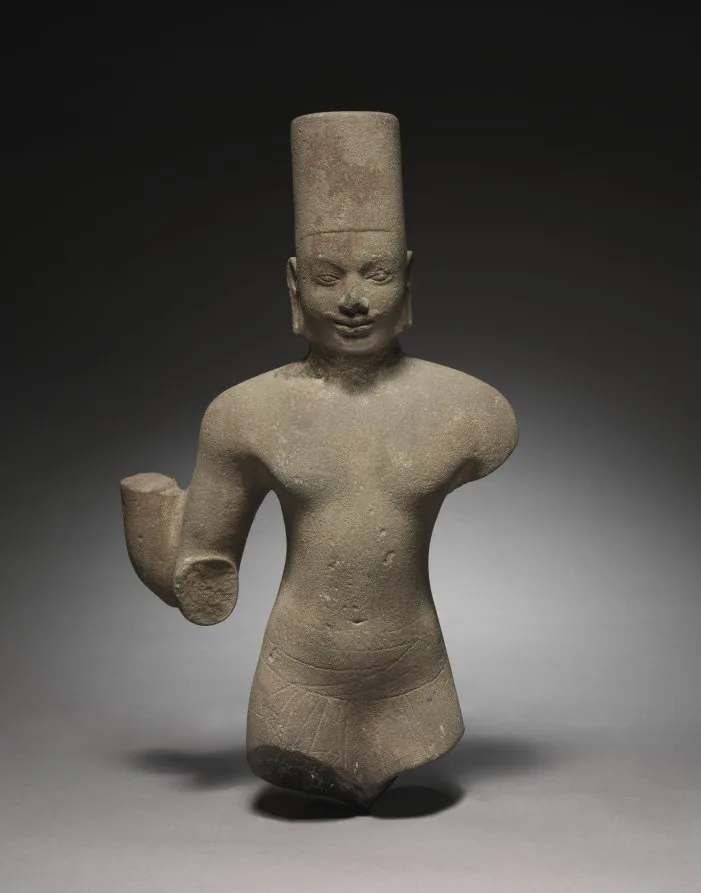
A high crown survives clearly, while broken arms require a more careful distinction between what remains and what the catalogue reconstructs.
The high flat-topped crown is the most immediately intact clue. Beneath it, softly modelled eyes, a slight smile, and a comparatively naturalistic torso give the figure a composed presence. The museum identifies Vishnu and connects the crown type with sculptures associated with Prasat Andet in Cambodia. The lower garment is a sampot, with another cloth tied around it.
The arms tell a more difficult story because so much is missing. The museum explains that the figure originally had four arms, running together from the shoulders before separating near the elbows. Surviving traces support that account, but the photograph does not preserve a complete set of hands and attributes. This is an opportunity to read damage responsibly rather than invent what is absent. Compare the reclining Vishnu on Ananta: both represent Vishnu, yet one presents a fragmented iconic body and the other a fully populated creation narrative. Identification, format, and survival all affect how much can be read directly.
The missing hands and lower body limit direct recognition of attributes. The museum identifies the four-arm arrangement from surviving traces; this guide does not reconstruct unseen objects or claim a complete original pose.