Deities, donors, and survival
Religious figures can share flowers, jewellery, or poised bodies without becoming identical. These six works show how precise gestures, nested figures, donors, and missing parts affect identification. Begin with what survives in the photograph, then follow the museum’s distinctions between a secure attribute, a probable relationship, and an absent original setting.
Begin the journey ↓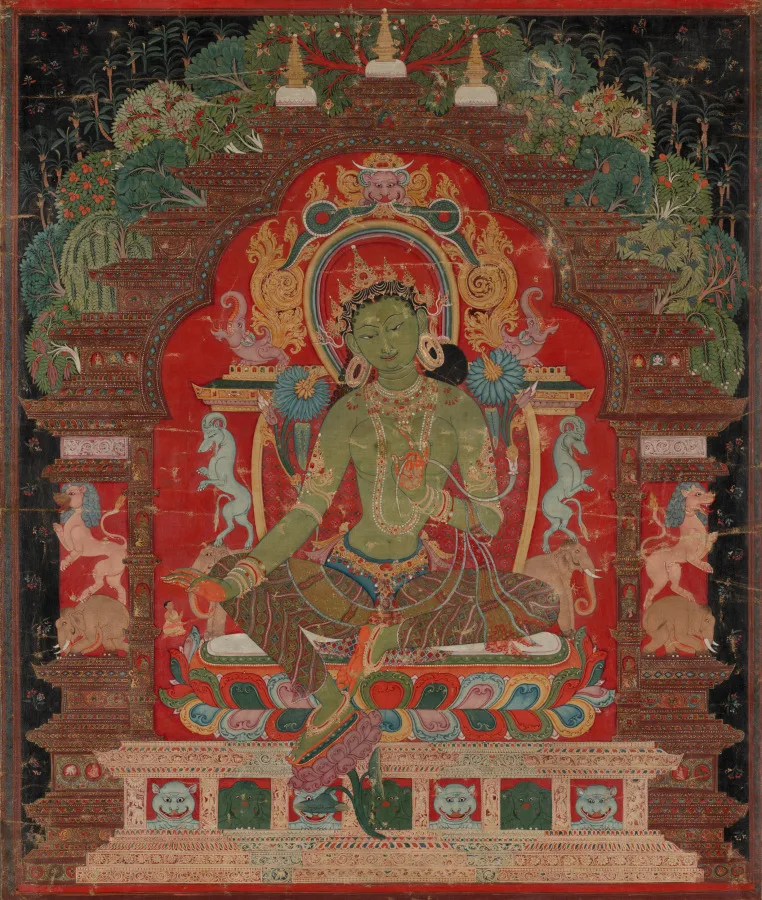
A donor below a protective figure
The tiny monastic commissioner occupies a different scale from Tara. Patronage enters the devotional image without turning donor and deity into equivalents, while the artist’s attribution remains qualified.
Carry this question: How does scale establish a relationship rather than a literal measurement?
Open the artwork ↗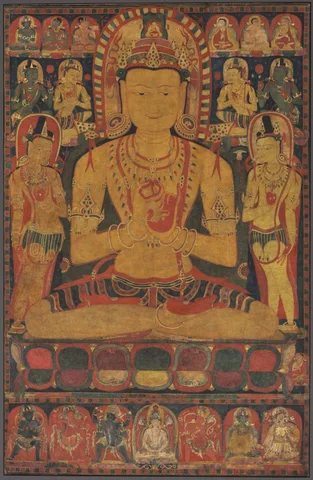
Read the exact fingers
One hand grasps the other’s index finger. The museum uses this precise configuration for identification, then adds other clues and a tentative account of the small teacher figure in the crown.
Carry this question: Why is the exact hand arrangement more useful than colour alone?
Open the artwork ↗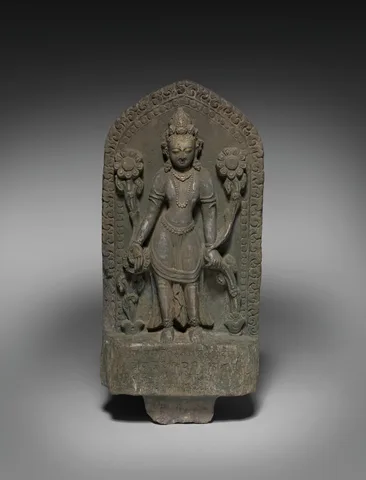
A figure inside a crown
The paired lotuses are conspicuous, but the tiny Amitabha in the crown adds another identification clue. Notice how a small nested image can change the reading of a much larger body.
Carry this question: Which details would disappear if you only looked from far away?
Open the artwork ↗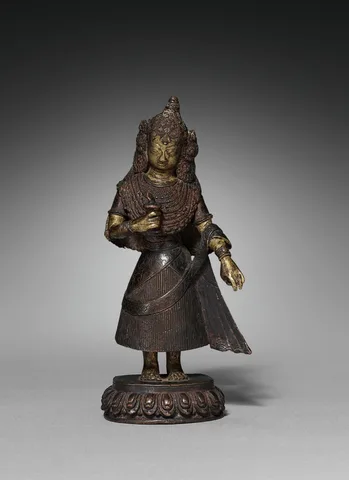
A lotus does not settle identity
The woman’s lamp and finery support a possible donor role. Her lotus base does not by itself prove she is a deity, and the absent original group keeps the identification cautious.
Carry this question: What prevents the pedestal from becoming a universal identity code?
Open the artwork ↗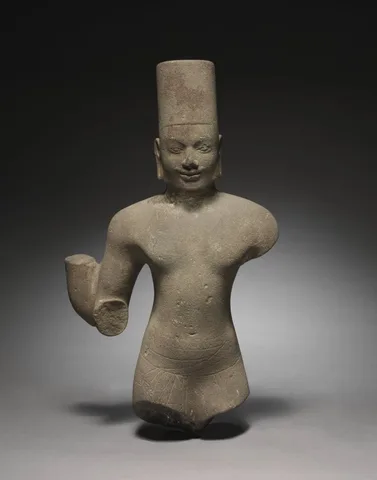
Use traces without inventing hands
The museum reconstructs four arms from surviving branches and stumps. Those traces are useful evidence, but missing hands prevent direct recognition of every object the figure originally held.
Carry this question: What can the surviving arm structure establish, and what can it not?
Open the artwork ↗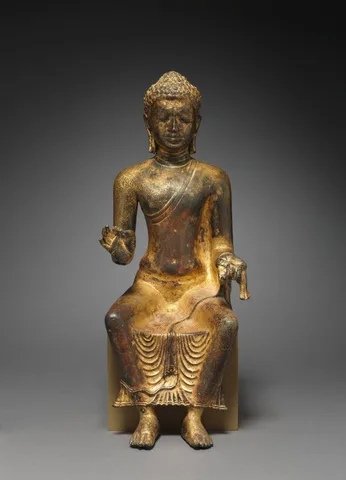
A figure outlives its throne
The pleated robe and teaching hand remain legible. The separately cast original throne does not survive in the displayed ensemble, so the present support should not be read as the original setting.
Carry this question: How would a missing throne have changed the encounter with this body?
Open the artwork ↗Look at a pair more closely
- Giving the donor a place
A tiny commissioner and a possible royal donor in bronze
Read with the sources
Historical context follows the individual museum records linked on each artwork page. These routes make original comparisons of visible form; resemblance alone is not evidence of shared meaning or direct influence.
- Green Tara — museum collection record
- Tantric Buddha Vairochana as Vajrasattva — museum collection record
- Bodhisattva of Compassion, Avalokiteshvara Padmapani — museum collection record
- Royal Female Donor — museum collection record
- Vishnu — museum collection record
- Enthroned Buddha Preaching — museum collection record