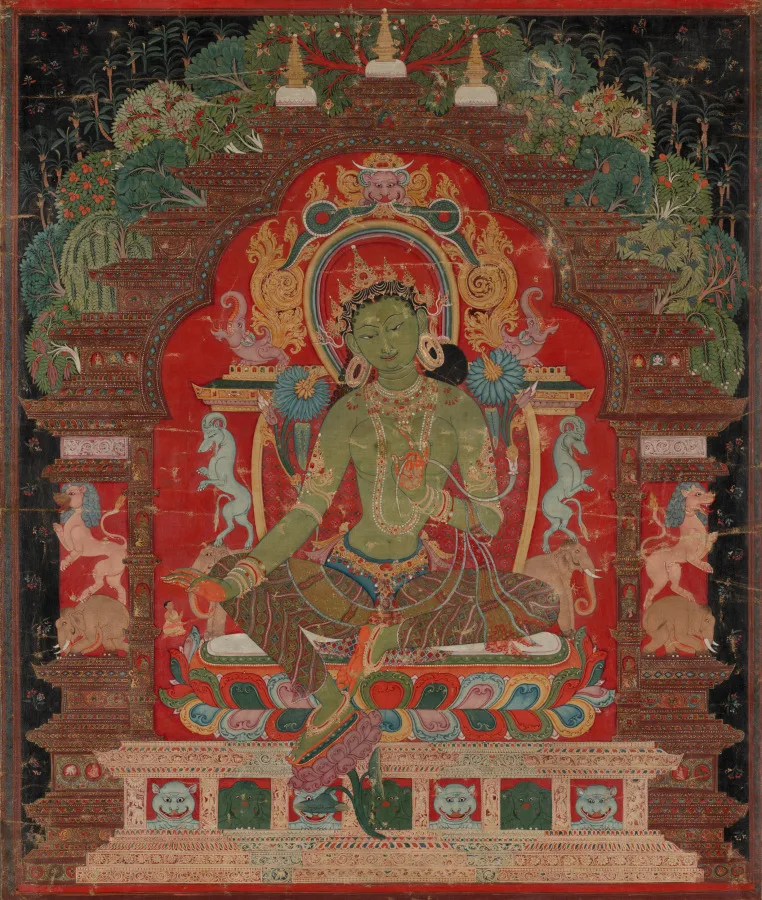
A large green deity and a tiny donor share one devotional painting, making protection and patronage visible at different scales.
The green figure dominates the painting, but her surroundings are far from empty. Blue flowers rise beside the shoulders, animals and smaller figures occupy the throne setting, and a tiny monastic donor appears below one hand. The difference in scale gives Tara immediate visual priority while preserving a place for the person who commissioned the image.
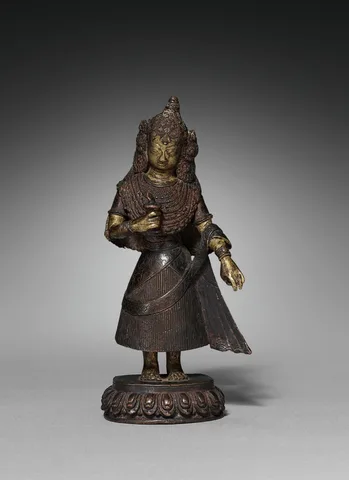
The museum identifies this Tibetan devotional painting as Green Tara, associated here with protection and the dispelling of fear. It attributes the work to Aniko, a Nepalese artist active in Tibet, while retaining that attribution as a qualification. The cloth painting also has a mantra on its reverse, which is not visible in the displayed photograph. That hidden side reminds us that a thangka was more than a front-facing picture. Compare the Royal Female Donor sculpture, where patronage takes a larger bodily form, to see how religious giving can enter an image without making donor and deity interchangeable.
The attribution to Aniko remains qualified. The reverse inscriptions, including Tara's mantra, are documented by the museum but cannot be read from this frontal view. The small donor is identified by role rather than by name.