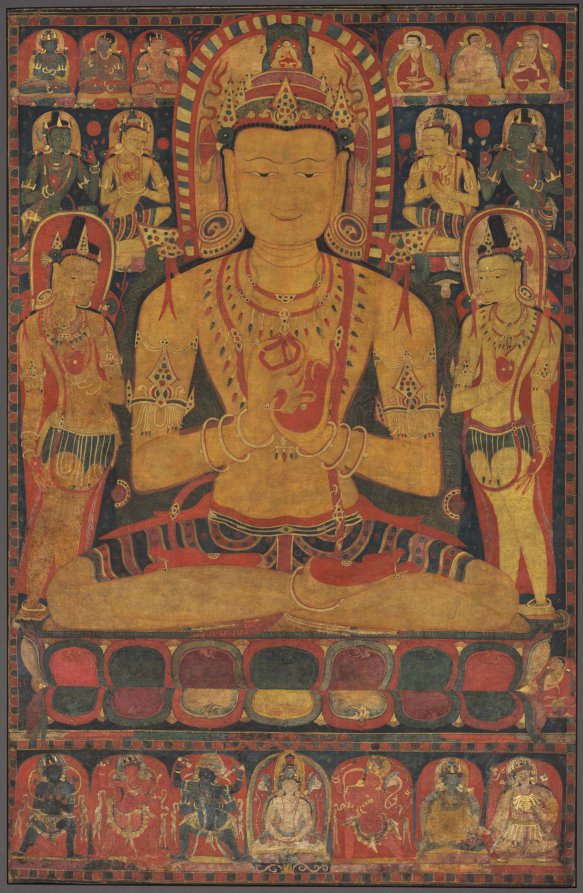
A precise meeting of fingers becomes a key identification clue within a crowded image of enlightened beings and human patrons.
The hands offer a more specific starting point than the golden colour alone. One hand encloses the raised index finger of the other, a gesture the museum uses to identify Vairochana. A tiny vajra above the finger and the golden body further suggest a manifestation as Vajrasattva. Several clues work together; no single colour provides the full identification.
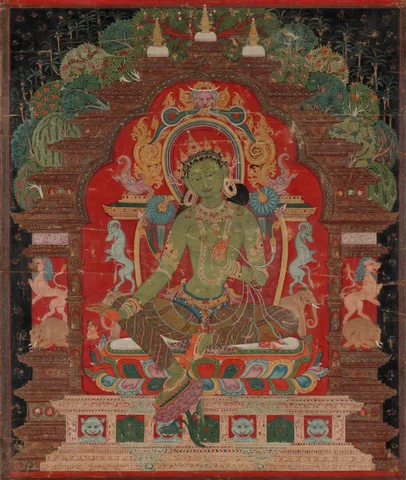
The composition surrounds the large central body with smaller sacred figures and a human donor. A monk in the crown is interpreted as probably the donor’s teacher, introducing a relationship between religious instruction and patronage. That identification remains tentative, unlike the directly visible difference in scale. The museum also records a mantra behind the figures, hidden from this frontal photograph. Read the image alongside Green Tara: both combine central sacred presence, smaller participants, and information that cannot all be recovered from one visible surface. The aim here is to understand the evidence, not to replace the teachings associated with the painting.
The monk in the crown is only probably identified as the donor’s teacher. The mantra on the reverse is documented by the museum but not visible here; even the small vajra above the finger needs a close view.
Which clue does the museum use specifically to identify Vairochana?
Practise looking at Tantric Buddha Vairochana as Vajrasattva →