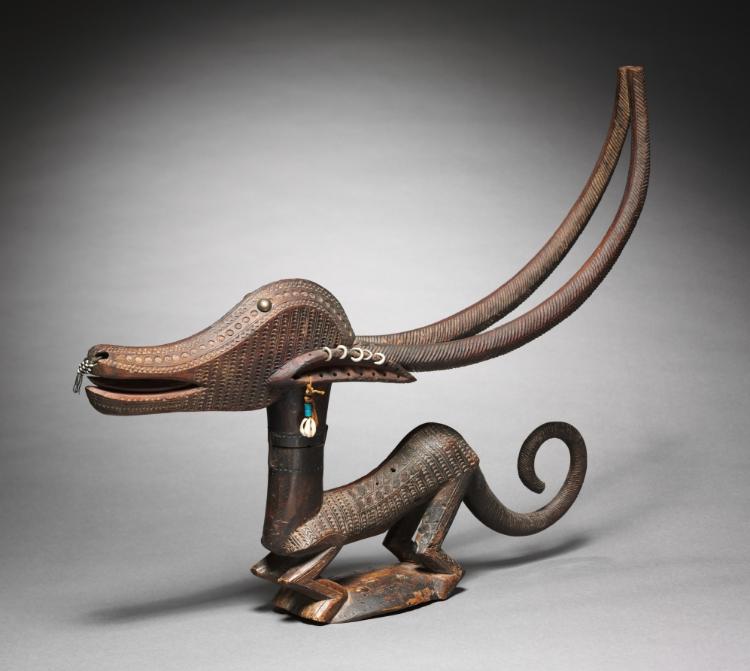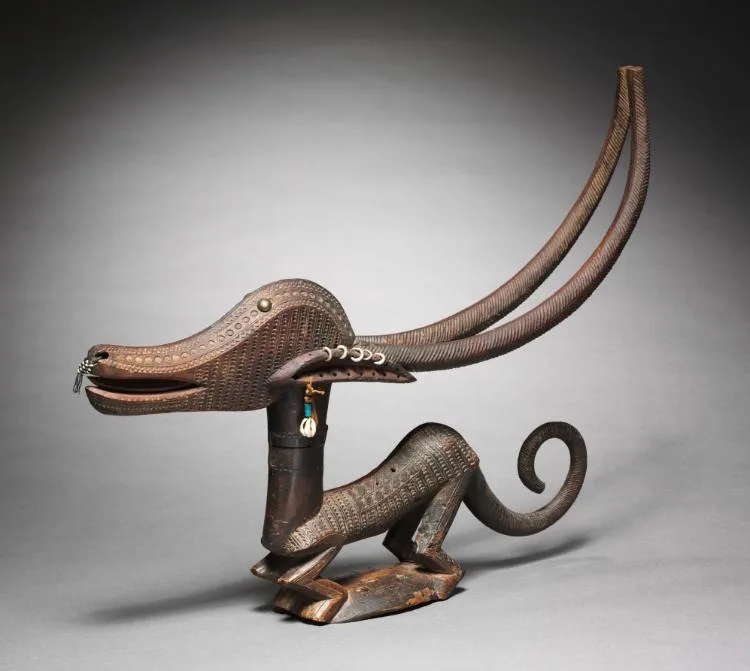
Long horns suggest an antelope, but the snout, carved patterns and adornments belong to a more complex agricultural being.
The horns make a sweeping line far beyond the body, but the snout and tail complicate an immediate identification as an ordinary antelope. Incised patterns cover the animal's muscles, and small ornaments add another scale of detail. The result is a deliberately composite form, not a wildlife model with a few accidental decorations.
The museum identifies this as a female chi wara, an agricultural spirit associated with teaching farming to the Bamana. It combines traits of humans, antelopes and anteaters. Paired male and female headdresses were carried by male dancers on basketry caps, accompanied by women's songs at agricultural competitions and weddings. This particular carving is linked stylistically to southern Mali, with qualification around the exact region. Its earrings and nose ornament include imported materials, showing how the identity of a locally meaningful spirit could be made with both carved wood and objects acquired through wider connections.
The southern regional attribution is inferred from style. Chi wara forms vary by region; this work should not be used as a single model for every Bamana headdress or performance.