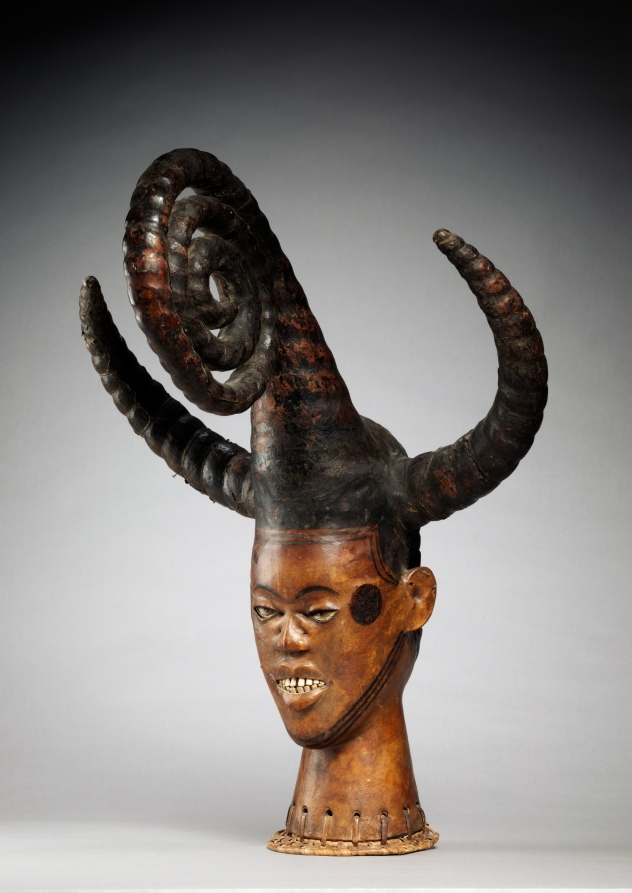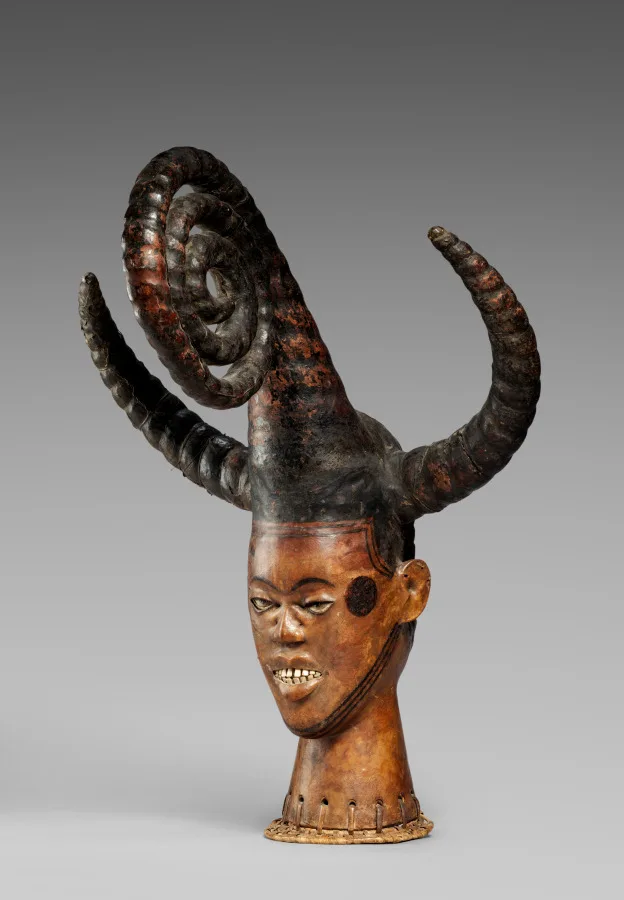
Sweeping coils of hair rise above a skin-covered face whose tiny surface impressions preserve clues to its construction.
The hairstyle carries the eye far beyond the face. Large curved projections rise and curl outward, while the face below remains compact, with narrowly opened eyes and visible teeth. The contrast between the dark hair and warm skin-colored surface is part of a complex construction: antelope skin was stretched over a carved wooden core.
The museum places the work in the Cross River region and identifies it as Ejagham-style. It probably belonged to the Ekpa women's society and represented an ideal of female beauty associated with preparation for marriage. The striking hairstyle is therefore culturally specific rather than an imaginary flourish detached from human appearance. Very small impressions around the eyes, nostrils and mouth record how twisted yarn held the damp hide against the carving as it dried. The object lets us connect an idealized face with practical making decisions, without pretending that the original wearer or ceremony can be recovered from the photograph alone.
Association with Ekpa and a female wearer is probable rather than certain. The skin covering and its manufacture are documented, but the photograph cannot reconstruct the complete costume or performance.