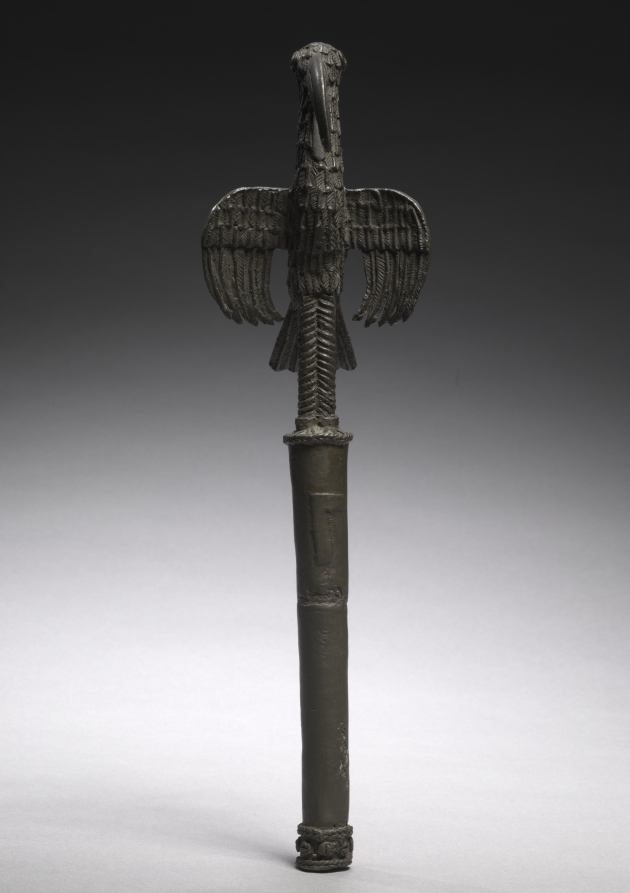
Spread wings and a long beak crown an instrument whose sound recalled a story about a failed prophecy.
The bird's spread wings make the upper part broad, while the long handle keeps the whole object strongly vertical. Individual feather divisions are easy to follow across the symmetrical silhouette. The form is not simply a bird on a pedestal: it belongs to an instrument that could be struck, adding sound to the represented creature.
The museum connects the bird with the reign of Ọba Ẹsigie and a prophecy of defeat during the Idah War. In the narrative, the ruler's victory exposed the prophecy as false, and bird effigies were struck to commemorate and rebuke that failure. Courtiers, priests and chiefs used such instruments during the Ugie Ọrọ festival. Image, sound and political memory therefore belong together. The visible beak and feathers make the story's creature present, but the particular historical meaning cannot be inferred from a generic bird shape alone. The instrument's date is also only approximate. The museum’s provenance records that this object was brought to Europe following the 1897 Siege of Benin.
The museum dates the object only as possibly nineteenth century. The substance associated with the beak is uncertain, and the historical narrative explains the instrument without making the photograph a witness to the original events.