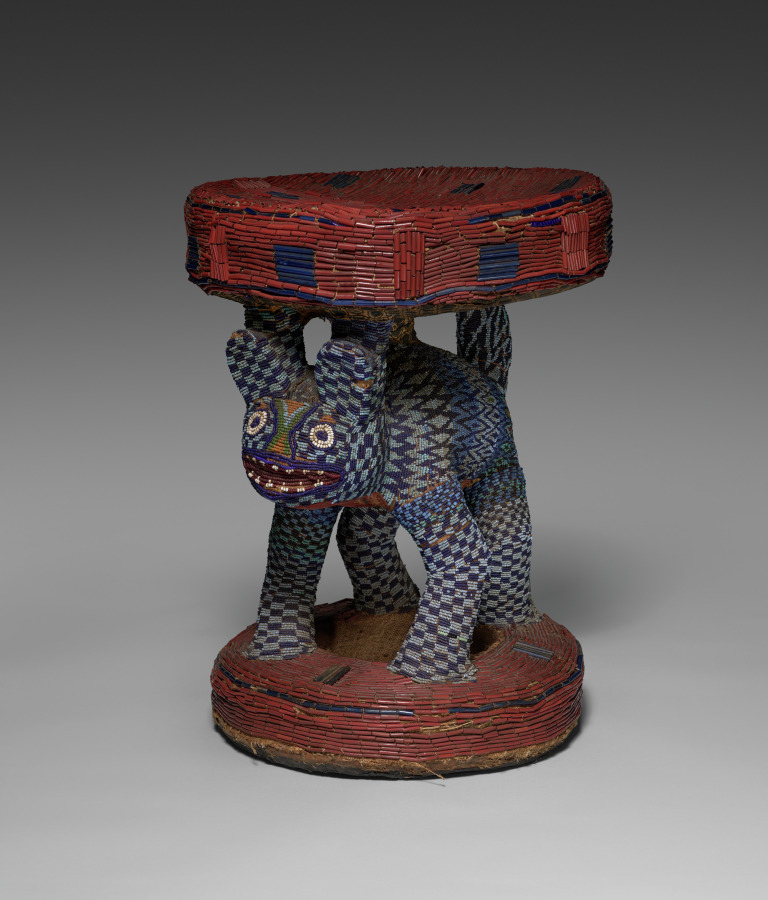
A leopard holds up a seat: the structure of this beaded stool makes an argument about royal power.
A stool has to hold a body up, and this one makes that ordinary requirement extraordinary. A leopard stands between the circular base and seat. Its stout legs are the supports; its head projects beyond them, so the animal remains visible even when someone sits above it. Color and repeated beads animate the entire construction.
Made in the Bandjoun Kingdom of the Cameroon Grassfields, the stool belonged to a royal treasury. The museum places it among travel stools used for relatively private ceremonies and rituals at the palace. Leopard imagery connected the ruler with a powerful predator and with the belief that a king could temporarily take its form. This is a specific royal association, not a rule that every spotted animal in art means kingship. The many hand-sewn beads also invite attention to the labor and materials through which an important seat was made impressive.
The date is given only as possibly the nineteenth century. A single photograph cannot show the stool’s full underside, construction or use in a ceremony; the museum’s contextual record supplies that information.