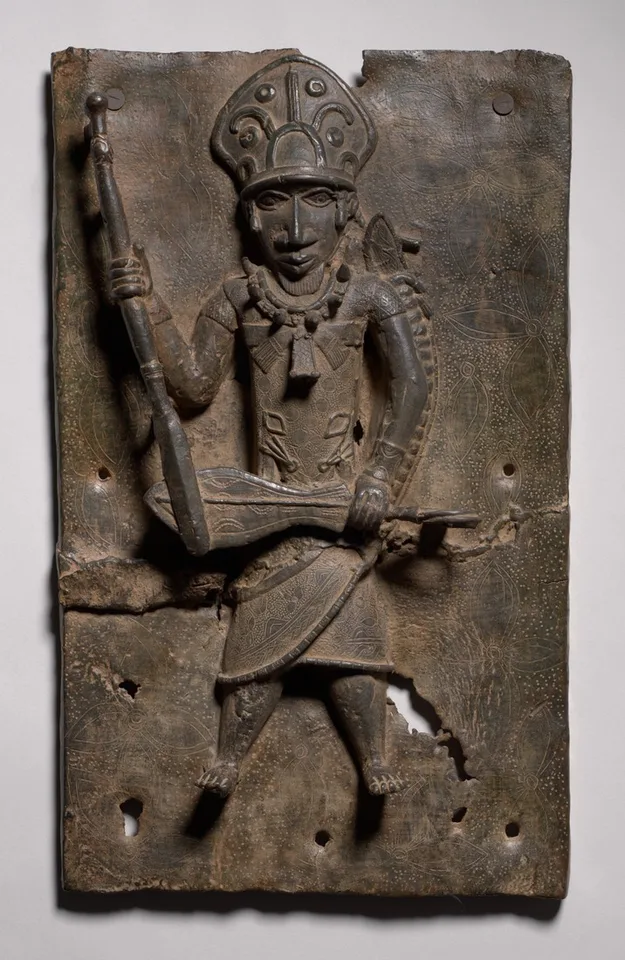
A warrior projects sharply from a patterned metal field, with a long staff and broad sword making rank visible through held objects.
Members of the Benin royal brasscasters’ guild modeled plaques in wax before casting them in metal. On this example a warrior stands forward of the flat background, carrying a staff and a court sword called an ẹbẹn. The museum explains that general figure shapes could be formed in molds and specific details added by hand. The distinction between deep modeling and shallow incised patterns remains visible across the surface.
The flowers in the surrounding field are identified as river leaves associated with Olókun, god of the waters, with possible Islamic or European sources for their design. Those connections belong beside the plaque’s collection history. The museum traces it to the royal palace until the 1897 Siege of Benin, then lists an uncertain possible link to Admiral Rawson before its later sale. The projecting figure and damaged metal are therefore not detached from the violent dispersal of the palace collection. The uncertain intermediate provenance should remain uncertain.
The palace history includes the 1897 Siege of Benin. The museum’s possible Rawson ownership is unconfirmed, and the photograph cannot reconstruct the plaque’s original position in the palace.