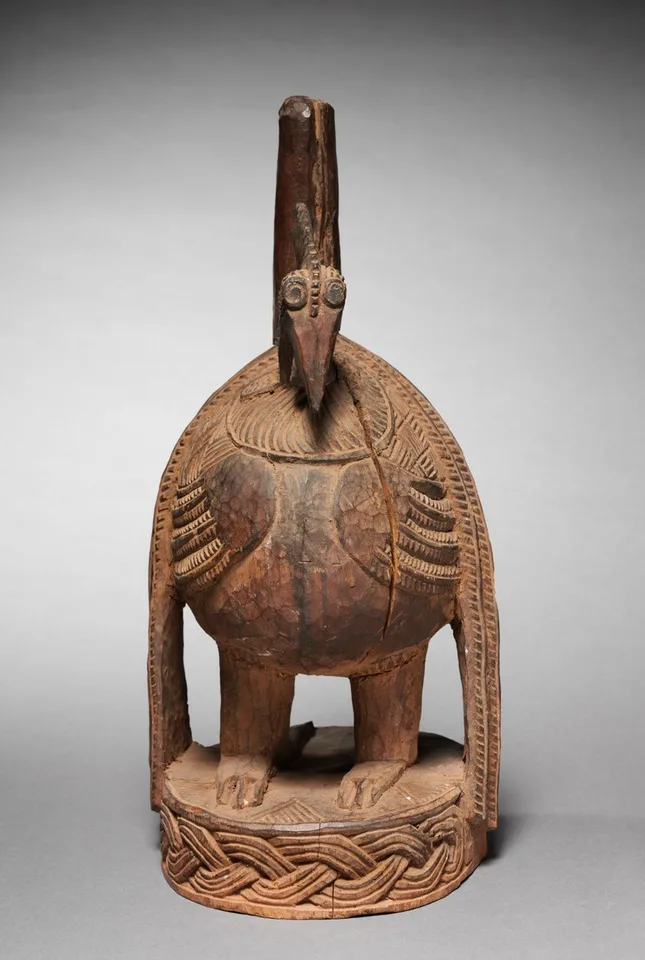
Parallel cuts turn a wooden bird’s rounded body into feathers, while a patterned base gives the standing hen a formal setting.
This wooden hen belongs to Benin ancestral altar traditions. The museum distinguishes carved hens associated with women from cast brass roosters associated with men, emphasizing that materials and animal forms related to the status of an owner or person commemorated. A hen like this stood with other objects on a woman’s shrine and represented an animal that could be offered there. The sculpture’s material is therefore part of its specific ritual context.
The bird’s egg-shaped body gives the carver a broad surface for different kinds of feather pattern. Fine curved cuts gather near the neck, while longer parallel bands organize the wings. Its small feet and strongly patterned circular base hold the upright form in place. Look at the contrast between the tall narrow head and the rounded breast: the sculpture reads clearly as a bird, but also as a carefully staged frontal presence. The museum dates this example to the 1900s, so it should not be folded into the 1897 history of earlier palace objects.
This twentieth-century hen has a different recorded history from Benin objects removed in 1897. The particular woman, altar and ceremonies associated with it are not identified.