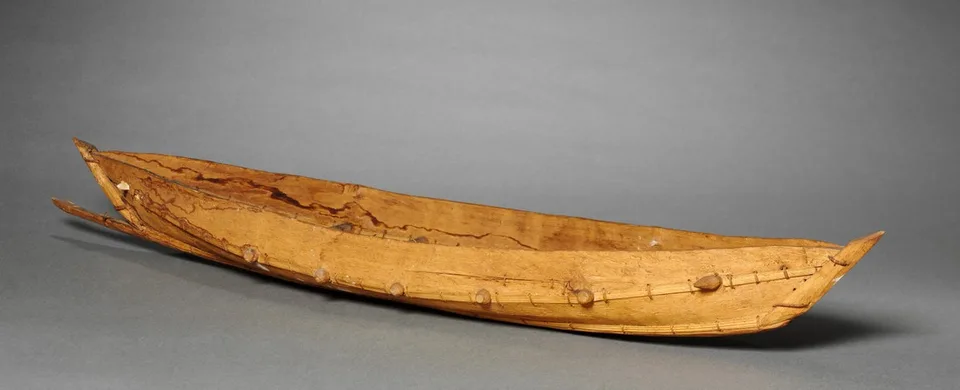
Tiny stitches along a long wooden hull preserve a construction method more revealing than the old label “war canoe.”
The museum cautiously associates this model with sewn-plank canoes from Uganda. Wooden panels joined by fibres form a long, shallow hull with rising ends. Historical records called it a war canoe, but the current description explains that information about the object is limited. The descriptive label should not outrun the surviving evidence: the construction is visible, while a particular military use is not demonstrated by the model itself.
Follow the line of small joins along the near side. They explain how a boat could be assembled from separate pieces instead of hollowed from one trunk. The museum records Paul Travis’s acquisition from an unidentified woman in 1928 and related archival references to the Sesse Islands of Lake Victoria. Those documents are useful but not perfectly complete. The catalogue title includes paddles, whereas this selected photograph chiefly presents the hull. The complete object record and the photographed view therefore convey different amounts of information.
The geographic association is probable and the historical “war canoe” label is not a secure functional identification. The selected photograph does not display every component listed in the title.