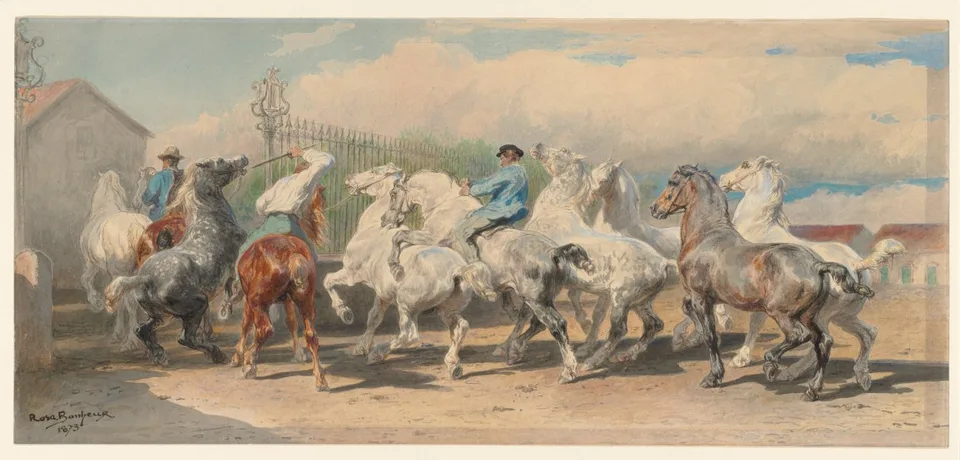
Horses form a moving band across the sheet, while riders, cropped tails, and an elaborate gate locate them in a managed world.
The horses seem energetic, but the image is strongly organized. Their bodies stretch across a shallow strip, with overlapping heads and legs giving variety to a repeated animal form. A dark horse lifts its forequarters near the left, while a brown horse at the right turns into the group. The long format gives the procession room to unfold without requiring a deep view into the distance.
The museum relates the animals’ carefully managed tails, the riders’ dress, and the wrought-iron fence to the French national breeding stables. These are therefore not simply wild horses gathered in an unspecified landscape. Bonheur was known for careful animal observation, and this watercolor with gouache displays close attention to anatomy as well as a controlled arrangement. Look at one leg or shoulder, then return to the whole line: the particular body and the larger group are designed to remain readable together, turning energetic animals into a coherent scene.
The scene is composed rather than a neutral record of every animal at a fair. The breeding-stable identification depends on a combination of details interpreted by the museum, not on one blue coat or one horse alone.