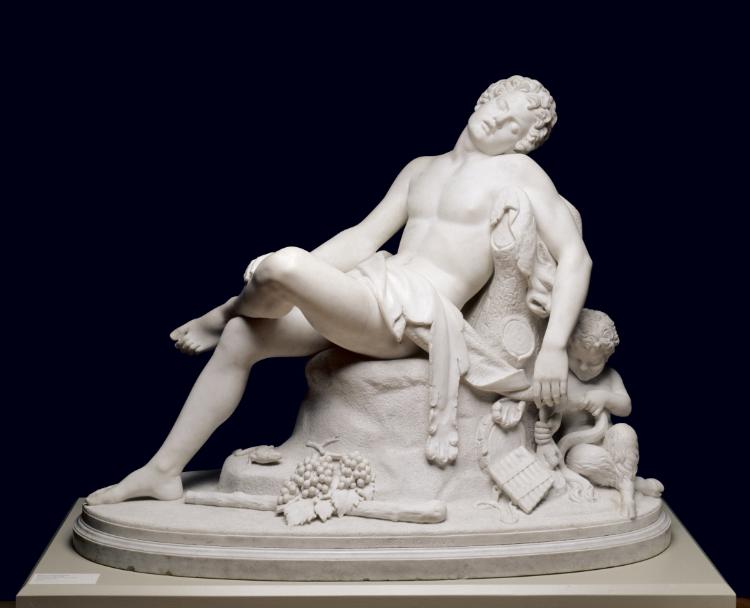
The sleeping figure seems to be the subject, until a small prankster beside the stump turns repose into a story.
The large figure looks entirely at rest. His head tips back, one leg crosses the other, and the loose arm seems to give weight to the hanging animal skin. Then the smaller figure at the right changes the scene: the museum identifies a satyr tying the sleeper’s garment to the stump. A picture of repose becomes a joke whose consequences have not yet happened.
Hosmer worked in Italy among a community of American artists and used a neoclassical language inspired by ancient Greek and Roman art. The polished marble bodies, woodland creatures, and carefully arranged props belong to that context, but the scene is not merely a solemn exercise in classical form. Look at the difference between the sleeper’s relaxed openness and the small figure’s concentrated action. The work invites us to know something the sleeping character does not. The photograph provides one useful angle, while the relationship among skin, hands, and stump would reward movement around the sculpture.
The scene involves classical woodland beings and a playful invented action, not documentary animal behavior. The museum’s distinction between the sleeping faun and the mischievous satyr supplies identities that anatomy alone might not clearly establish.