Interlocked bodies make conflict legible in marble, but a dramatic title does not turn this scene into a documented historical event.
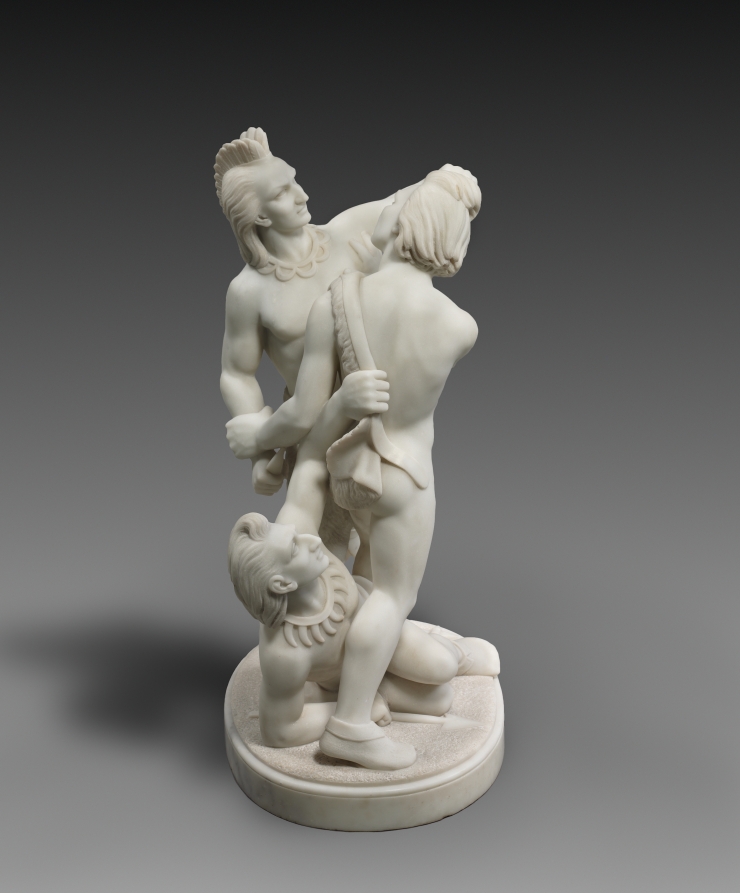
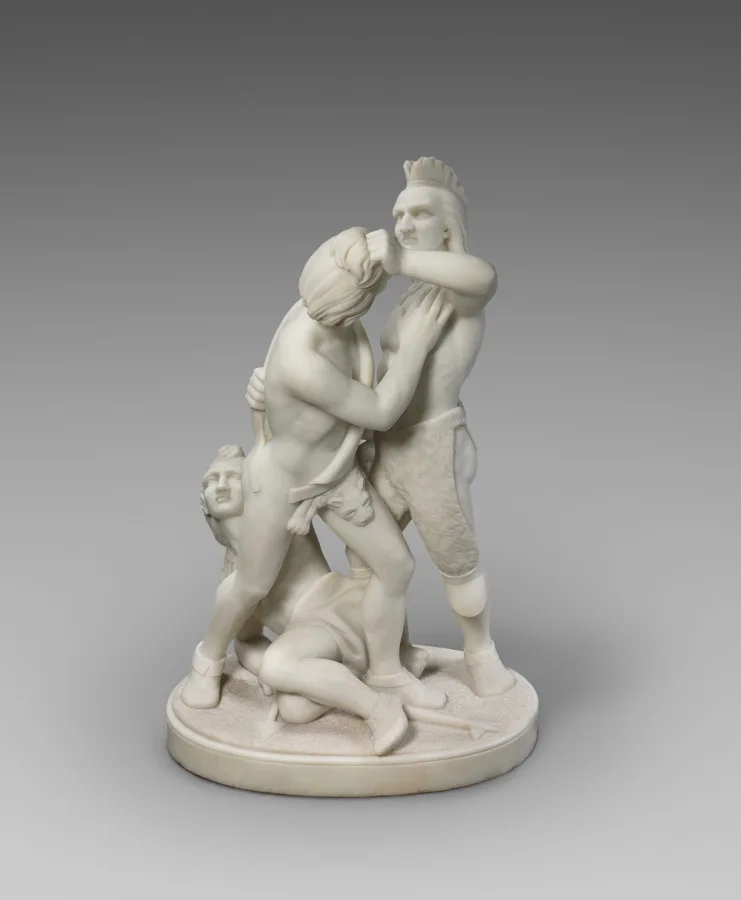
The group is difficult to take in as three separate silhouettes. Arms cross, bodies overlap, and a lower figure fills the space between the standing legs. Lewis makes that difficulty productive: the eye has to travel around the implied spiral to understand the struggle. In this frontal photograph, some limbs are concealed, reminding us that sculpture was made to occupy space rather than only one fixed view.
The museum identifies Edmonia Lewis as an artist of Mississauga and African American ancestry who moved to Rome after study and training in the United States. It describes this work as an unusually complex and apparently unique example among her Native American subjects. The historical title is retained here, but the supplied record does not identify a particular battle or named participants. We can discuss the movement, headdress, and arrangement of bodies without treating the imagined scene as documentary evidence of how Indigenous people lived or fought.
The museum does not identify a particular historical battle or individual participants. The work’s historical title and stylized clothing should not be used to generalize about all Indigenous communities or to claim an eyewitness account.