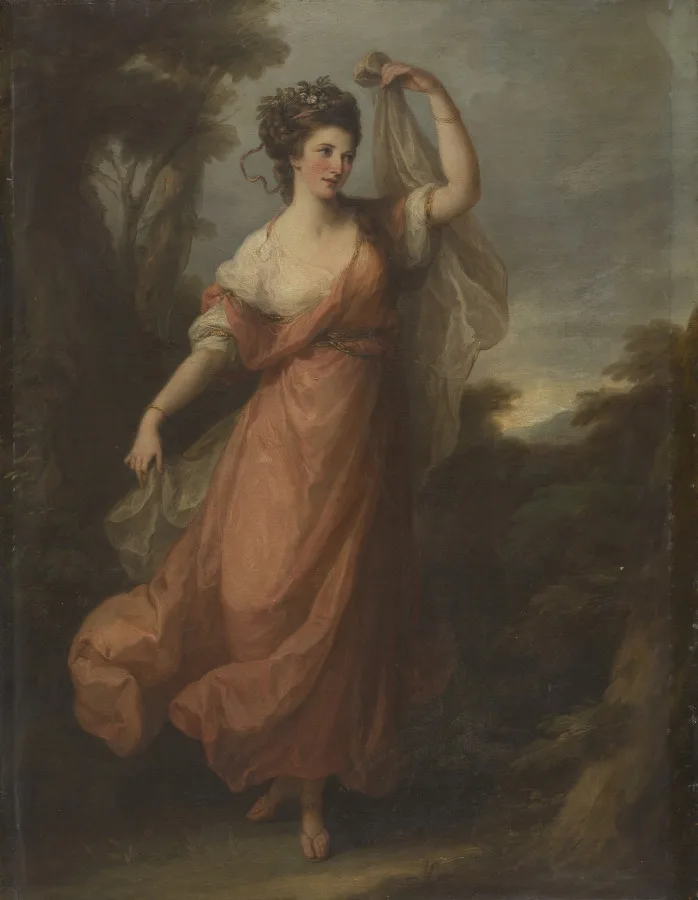
Lifted cloth turns a standing figure into a dancer, carrying an ancient visual idea into an eighteenth-century painting.
The raised arm is the clearest beginning, but movement continues through the hanging fabric and the light crossing of the feet. The woman is presented as Terpsichore, the classical figure associated with dance. Kauffmann does not need to show a whole performance or an audience: the arrangement of one body and its drapery supplies the action. The dark landscape lets the figure’s lighter clothing remain prominent.
The museum connects this pose with wall paintings uncovered at Herculaneum, an ancient Roman town. Those discoveries offered eighteenth-century artists new models for imagining antiquity. Kauffmann’s figure is a creative response to that material rather than a literal reconstruction of an ancient dancer’s life. The painter was also an accomplished musician and a founding member of Britain’s Royal Academy. Those facts make the subject an engaging meeting of artistic interests, while the visible evidence remains the flowing cloth, poised feet, and carefully balanced arms.
The Herculaneum connection concerns artistic inspiration, not proof of a documented ancient performance. The title supplies the mythological identity; a dancing pose by itself would not securely identify Terpsichore in every work.