Flying birds and curling plants turn a bowl into evidence of motifs travelling and acquiring new associations across regions.
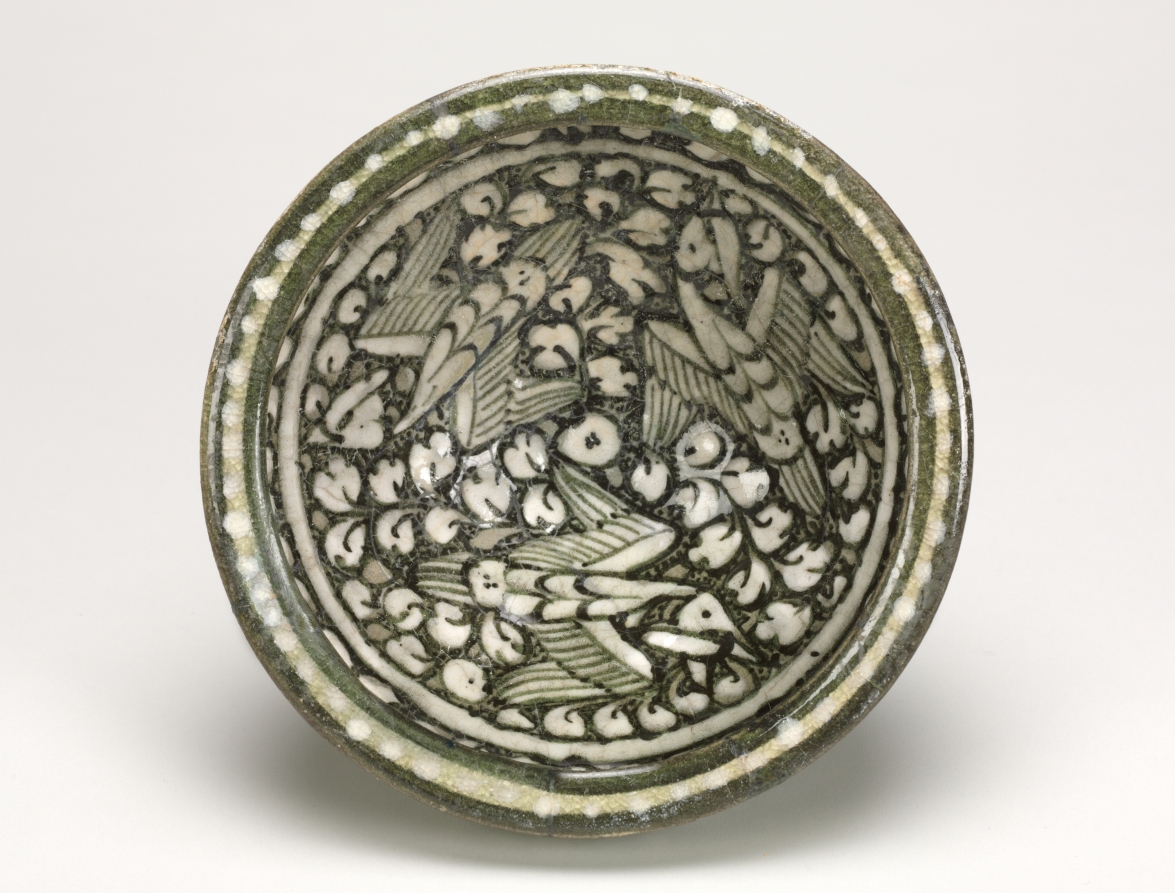
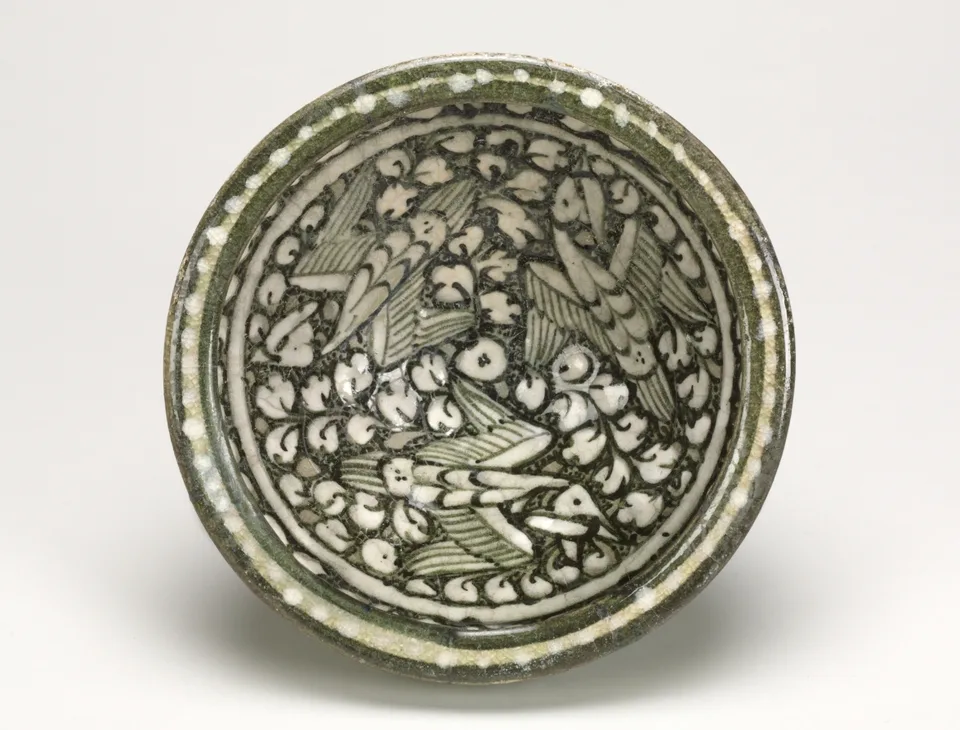
Several large birds fill the bowl’s interior without settling into a single upright direction. Their spread wings and long curving forms fit among closely packed flowers and foliage, inviting the viewer to turn the vessel mentally. Pale designs stand out from a grey ground, while the flat rim holds the crowded centre within a narrow circular boundary.
The museum places the bowl in Iran during or after the Ilkhanid period and describes the adoption of Chinese motifs into Persian art. The phoenix could be understood alongside the simurgh of Persian literary tradition, while lotus forms entered an existing repertoire of plant ornament. This is an example of adaptation, not proof that the same image carried an identical meaning everywhere. The museum also notes that related pottery travelled widely and may have been imitated. A useful way to read the bowl is therefore to hold two scales together: the visible organisation of birds on this vessel, and the wider movement of designs, objects, and stories.
The museum records the production place as probably Kashan. Connections between Chinese phoenix imagery and the Persian simurgh describe historical adaptation; they do not establish one precise story for every bird on this bowl.