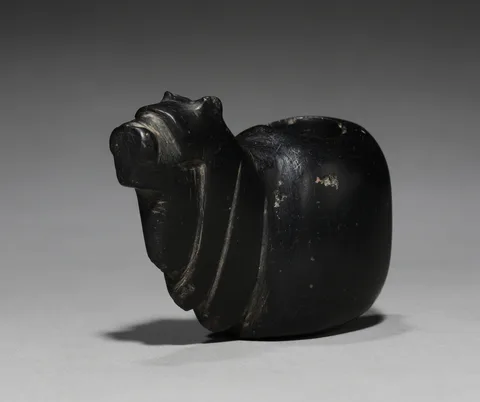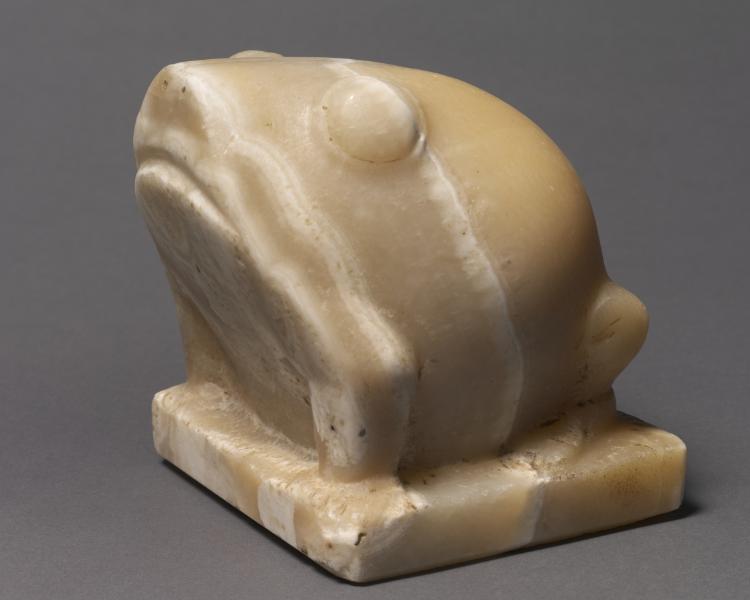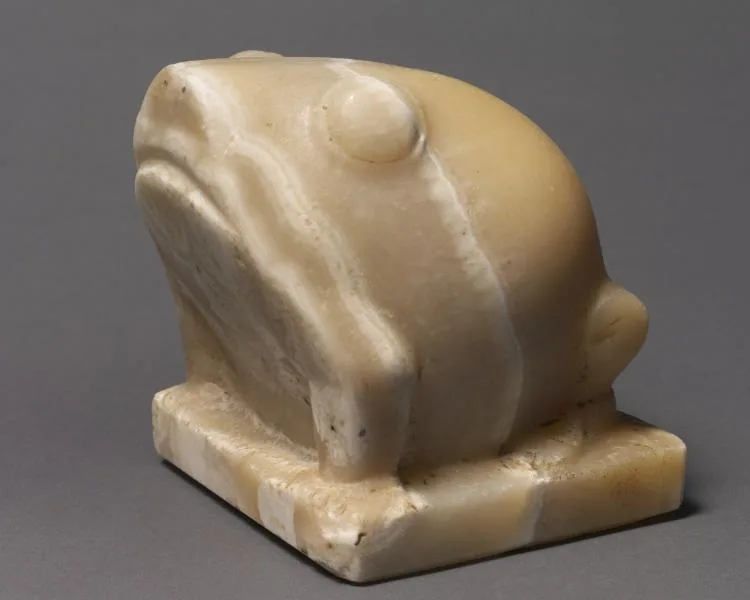
Follow the pale bands through this compact animal to see a sculptor working with the pattern already inside the stone.
The animal is reduced to a few wonderfully legible forms: projecting eyes, a curved mouth, close-set forelegs and a swollen body. It remains recognizably frog-like without recording every fold or texture of a living creature. Light and dark bands in the travertine sweep across the volume, helping the rounded body feel full.
This very early Egyptian sculpture is commonly titled as an image of Heqat, a goddess associated with childbirth in later periods. The museum is more cautious about the animal's exact significance at this early date. Small frog images occur among offerings at early temple sites, but that evidence does not prove that every such image already carried the later goddess's meaning. The work is therefore a useful invitation to look in two stages: first at the maker's handling of animal and stone, then at the historical limits of an attractive identification. Even the creature may be more accurately described as a toad.
The early religious meaning is unknown. “Heqat” reflects a later association; the museum also suggests that the creature is probably a puffed-up toad rather than a frog in a strict zoological sense.