Read the
Picture
An open collection
Japan, Nanbokuchō period (1333–92) to Muromachi period (1392–1573) · Painting

Kasuga Deer Mandala

Maker unrecorded · mid-1300s–1400s

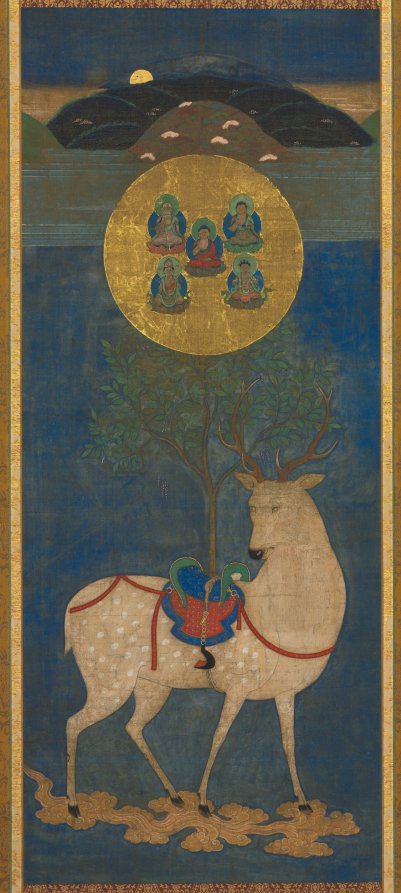
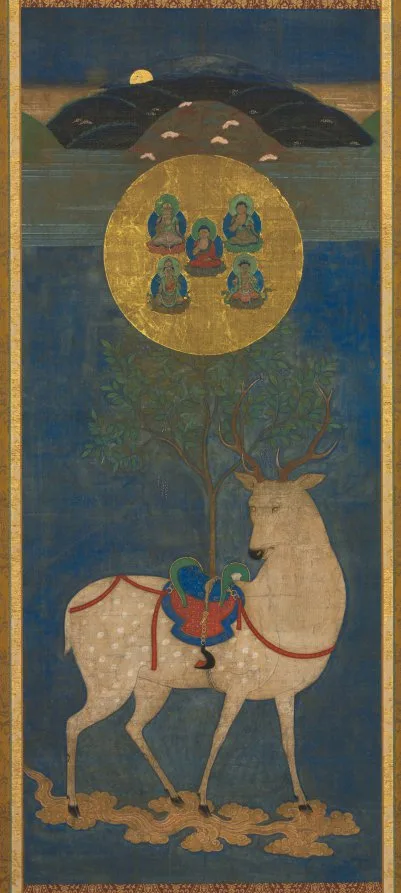
A pale spotted deer stands on a curling cloud beneath a dark blue landscape. Its colourful saddle supports a branching tree. A large gold circle containing five small seated figures hangs above the deer, framed by foliage. Dark mountains and a small bright moon occupy the upper part of the tall painting.
100%

Drag to move · Pinch or +/− to zoom · Arrow keys to pan · 0 to reset

The Cleveland Museum of Art · 1988.19 · Image: CC0Museum image ↗
A little context

A deer carries a mirror full of sacred figures, joining a recognisable animal to a particular Japanese devotional landscape.

The deer is not simply wildlife in a landscape. It carries an elaborate saddle, a tree, and a great golden mirror containing five small sacred figures. The museum connects the animal with Takemikazuchi no Mikoto, a deity associated with the first shrine hall at Kasuga in Nara. The mountains above also help identify the sacred place rather than a generic setting.

Within the mirror are Buddhist manifestations of the shrine’s kami. The painting therefore makes relationships between Buddhist and local shrine traditions visible through the arrangement of bodies, landscape, and objects. It is important to keep that historical specificity: a deer elsewhere need not carry this same meaning, and the term mandala does not always imply the same geometric design. The museum suggests that this scroll was made for someone’s personal devotion. Its narrow format gives the eye an ascending route from the cloud beneath the animal to the shining disc and then the mountainous distance.

A careful reading

The proposed personal devotional use is the museum’s inference. The deer and mirror belong to the particular religious history of Kasuga; this reading should not be extended to every Japanese deer image or every mandala.
Try your eye

Which detail most clearly prevents reading this as only a wildlife picture?

Where this reading begins

  • Kasuga Deer Mandala — collection record — The Cleveland Museum of Art. Supports object identification, dating, materials, attribution, and the contextual interpretation distinguished from direct visual observations in this guide. Museum record updated 2026-08-03; accessed 2026-11-13.

Our observations describe the supplied museum photograph. Historical identifications and context follow the cited collection record; interpretive limits are stated above. This is an independent guide, not a museum endorsement.

Image rights & attribution

Kasuga Deer Mandala (春日鹿曼荼羅図), mid-1300s–1400s. Japan, Nanbokuchō period (1333–92) to Muromachi period (1392–1573). Hanging scroll; ink, color and gold on silk; image: 95.6 x 39.1 cm (37 5/8 x 15 3/8 in.); mounted: 184.2 x 63.8 cm (72 1/2 x 25 1/8 in.). The Cleveland Museum of Art, Leonard C. Hanna Jr. Fund, 1988.19

Individual API record marked CC0; checked 2026-11-13. CC0 1.0 dedication. Record date: 2026-08-03 14:21:43.912000. Web JPEG downloaded unchanged; responsive WebP and zoom derivatives resized and recompressed; numbered annotation overlay separate from image.