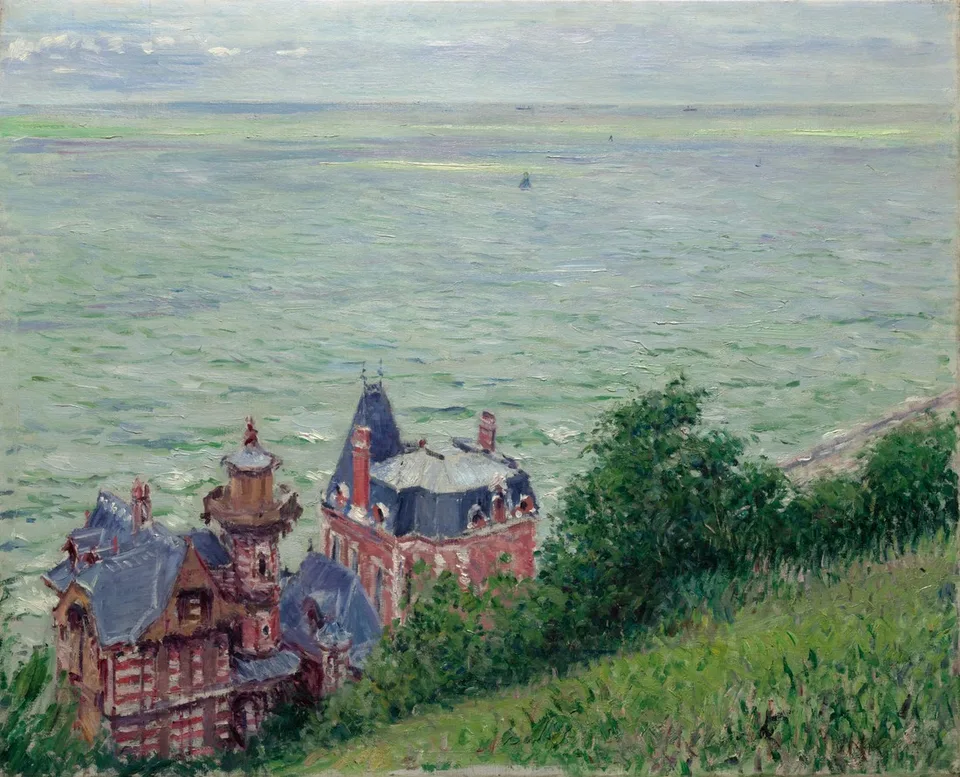
From above the villas, the sea expands while expensive houses become small, partly hidden footholds on the coast.
The viewpoint looks down across roofs rather than approaching their front doors. Turrets, chimneys, and steep dark rooflines make the brick villas intricate, but trees and the descending hillside partly conceal them. Beyond, the sea occupies most of the picture. Small sailing forms nearly disappear within its pale green and blue marks, creating a strong contrast between architectural detail and open extent.
Caillebotte painted this view from a cliff at Trouville, a Normandy resort where he spent several summers in the early 1880s. The museum identifies the villas as private shoreline retreats just outside the town’s center and connects his visits with painting, friends, and sailing regattas. The coast is therefore a place shaped by leisure and property, not simply empty nature. Looking at how the houses cling to the lower edge helps reveal that relationship: private buildings frame access to a view that appears visually limitless.
The villas signify private retreat in the museum’s account, but the painting does not identify every occupant or boundary. Its wide view should not be confused with unrestricted public access to the shore.