A web between barren branches is small enough to miss, yet it changes the space around a solitary seated figure.
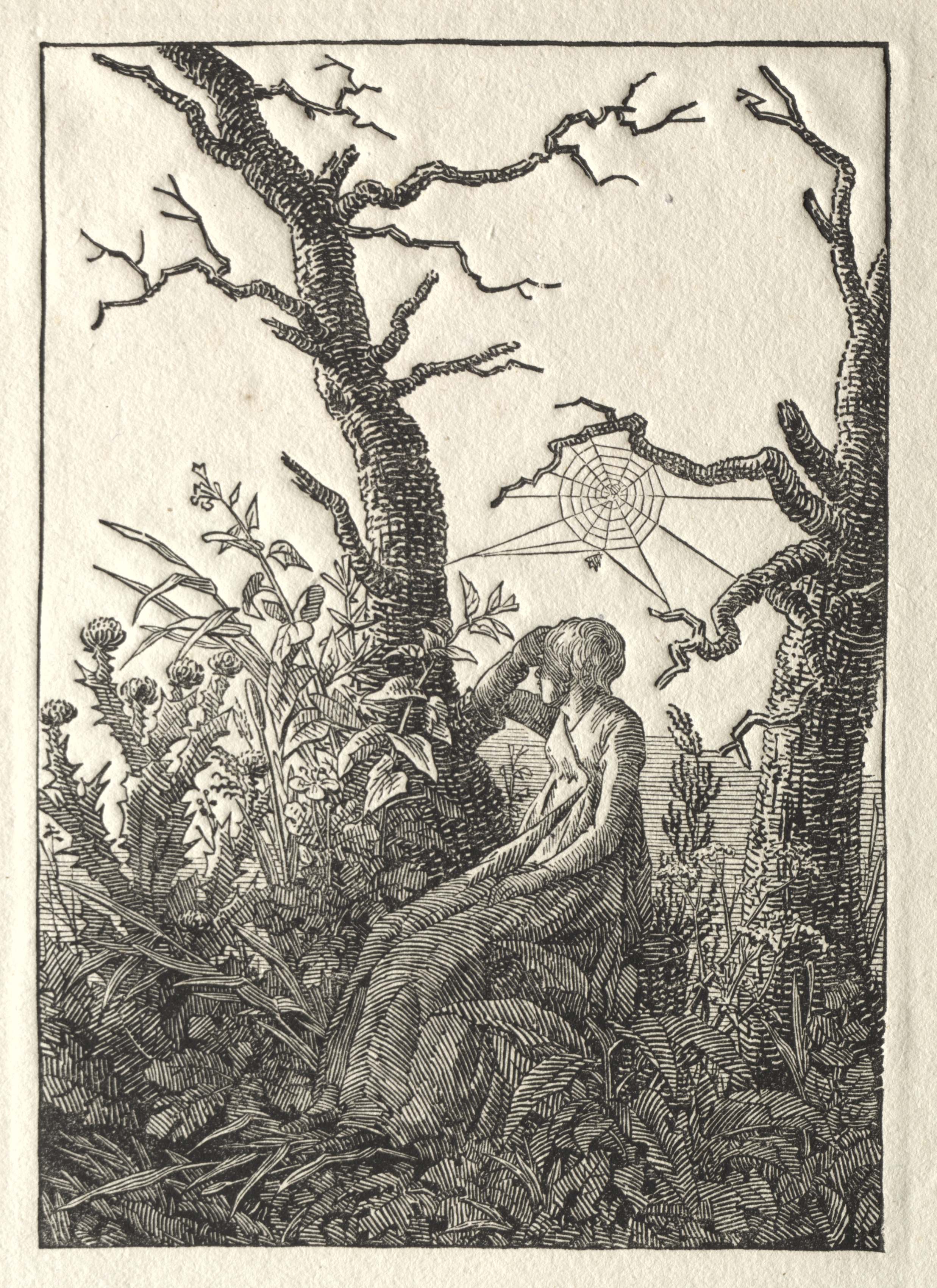
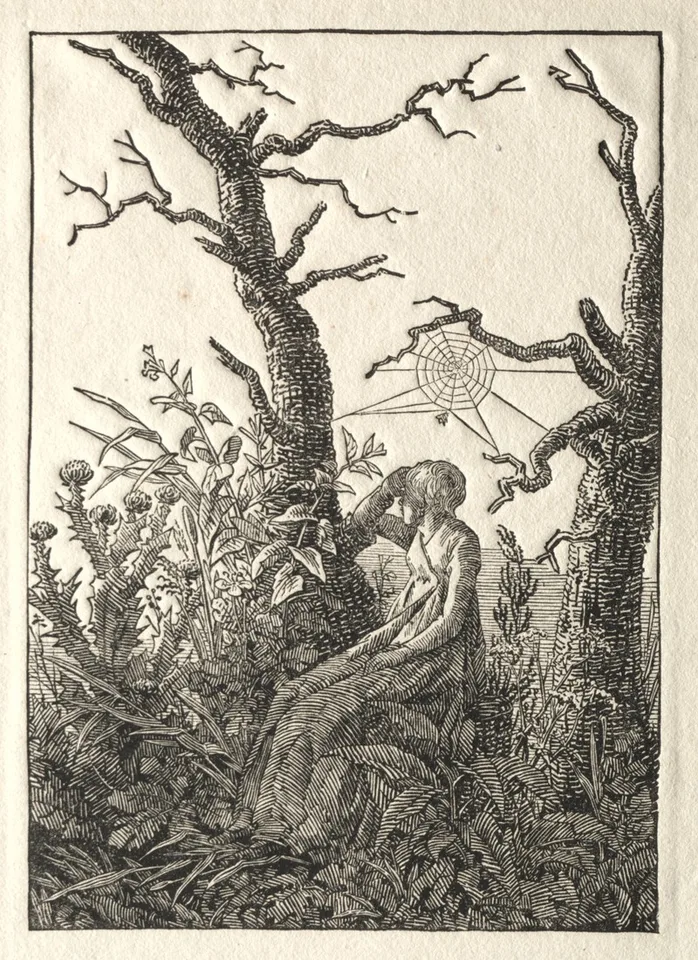
The woman occupies the lower part of the print, surrounded by plants whose sharp leaves and flower heads crowd close to her body. Above her, the branching trees open onto a pale area of sky. A carefully drawn web interrupts that emptiness. Its delicate geometry contrasts with the jagged trunks, making a fragile structure seem momentarily as important as the much larger trees.
Friedrich understood landscape as a means of spiritual reflection. The museum relates the barren trees, thistles, caught insect, and evening setting to mortality and describes the woman’s pose as a searching, unresolved awareness. Those associations should not turn the print into a puzzle with a single guaranteed solution. Its force comes partly from the difference between unusually clear objects and uncertain overall meaning. The woman looks beyond the scene’s immediate details, while our attention moves between her inward-seeming posture and the surrounding natural forms.
The museum offers a spiritual and mortality-centered reading, but the woman’s exact thoughts are unknowable. A symbolic association does not make every plant a fixed universal code.
What makes the web especially noticeable once found?
Practise looking at The Woman with the Spider Web between Bare Trees →