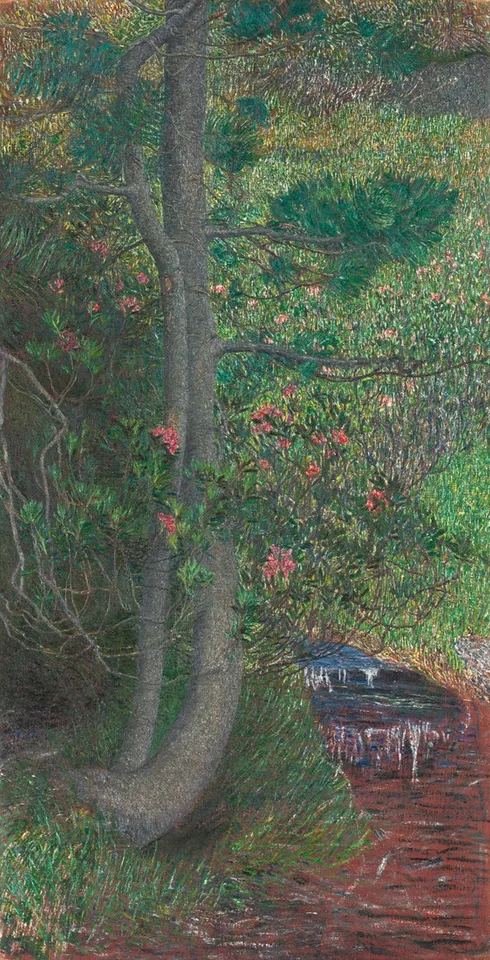
The pine fills a narrow field so completely that landscape becomes a dense encounter with bark, needles, and moving color.
The trunk enters close to the viewer, curves near the bottom, and continues upward beyond the frame. Branches push across the narrow field, leaving almost no broad opening through which to escape into a distant panorama. Small strokes of green, gold, blue, and red keep the surrounding vegetation active. At the lower right, pale strokes cross a darker reddish passage that the museum identifies as partly unfinished, with the ground layer still visible.
Segantini painted the tree in the Swiss Alps, where he found spiritual consolation in forest and light. The museum stresses that this is not a straightforward transcription of a view: the close crop and flattened decorative space aim at an emotional response. That interpretation is grounded in the painting’s actual arrangement. Instead of measuring a mountain from afar, we meet a tree at an intimate scale. The broken colors connect bark, needles, and flowers, while the exposed ground at the lower right reveals part of the painting’s unfinished construction.
The close view is composed to evoke feeling rather than provide a complete botanical or topographic record. Segantini’s spiritual response to nature should not be assumed to describe every viewer’s experience.