Read the
Picture
An open collection
Netherlands · Painting

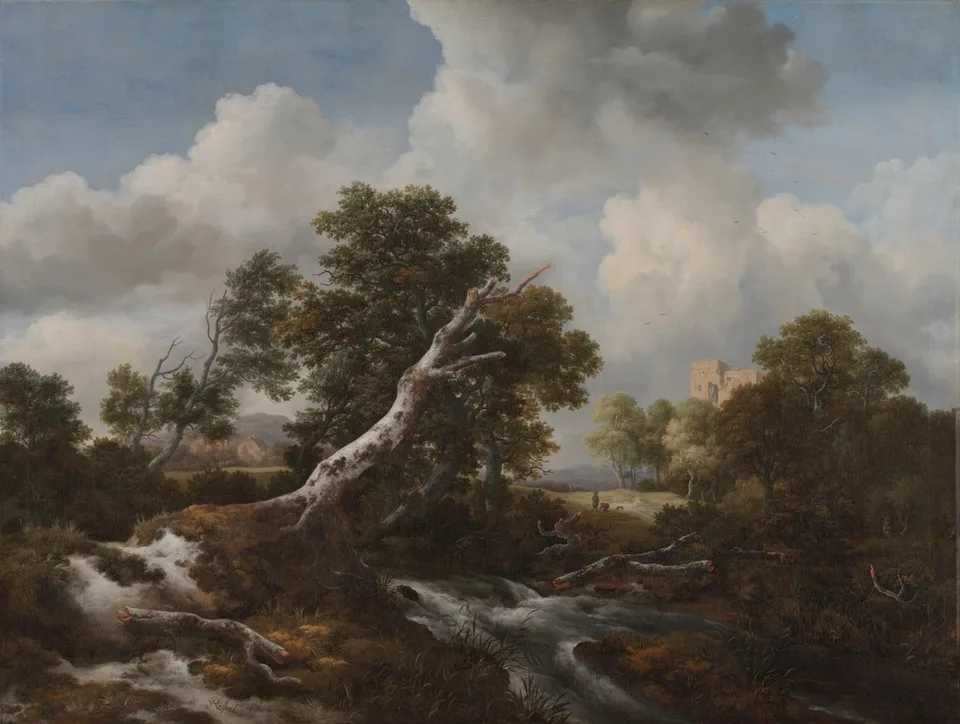
Low Waterfall in a Wooded Landscape with a Dead Beech Tree

Jacob van Ruisdael (Dutch, 1628/29–1682) · c. 1660–70

A pale dead tree trunk rises diagonally from a rocky bank beside a low rushing waterfall. Dense green trees gather behind it, while a sunlit path and tiny travelers appear farther away. A partly hidden ruined building stands at the right. Large white and gray clouds tower above the dark, uneven foreground.
100%

Drag to move · Pinch or +/− to zoom · Arrow keys to pan · 0 to reset

The Cleveland Museum of Art · 1967.63 · Image: CC0Museum image ↗
A little context

The dead tree points across moving water toward a sunlit distance, joining several different measures of passing time.

The pale trunk makes the strongest diagonal in the picture. It rises from a dark bank, interrupts the leafy trees, and points toward the cloud-filled sky. Below it, water breaks into white streams around rocks and fallen wood. Beyond these obstacles, a brighter path and small travelers offer a quieter area of movement. The foreground’s broken surfaces make that distant openness especially appealing.

The museum connects Ruisdael’s dead trees, waterfalls, and ruined buildings with the passage of time. Here, those elements also perform distinct compositional tasks: the trunk directs, the water crosses, and the ruin marks a distant point. The sky adds another changing system through light and cloud. Reading these relationships first keeps the symbolic account grounded in what we can see. The landscape becomes more than a catalogue of emblems because its materials and spaces remain convincingly varied, from hard dead wood to unstable water and illuminated air.

A careful reading

The museum’s account of time offers a contextual interpretation, not a universal key to every dead tree. The image does not identify a particular historical event behind the ruin.

Try your eye

Which pairing most clearly contrasts stillness and movement?

Where this reading begins

Our observations describe the supplied museum photograph. Historical identifications and context follow the cited collection record; interpretive limits are stated above. This is an independent guide, not a museum endorsement.

Image rights & attribution

Low Waterfall in a Wooded Landscape with a Dead Beech Tree, c. 1660–70. Jacob van Ruisdael (Dutch, 1628/29–1682). Oil on canvas; framed: 123 x 157 x 9.5 cm (48 7/16 x 61 13/16 x 3 3/4 in.); unframed: 99.2 x 131 cm (39 1/16 x 51 9/16 in.). The Cleveland Museum of Art, Mr. and Mrs. William H. Marlatt Fund, 1967.63

Individual API record marked CC0; checked 2026-11-14. CC0 1.0 dedication. Record date: 2026-10-09 11:23:45.499000. Museum print JPEG retained unchanged as original. Overview JPEG and responsive WebP and zoom derivatives resized and recompressed from that same complete print photograph; numbered annotation overlay separate from image.