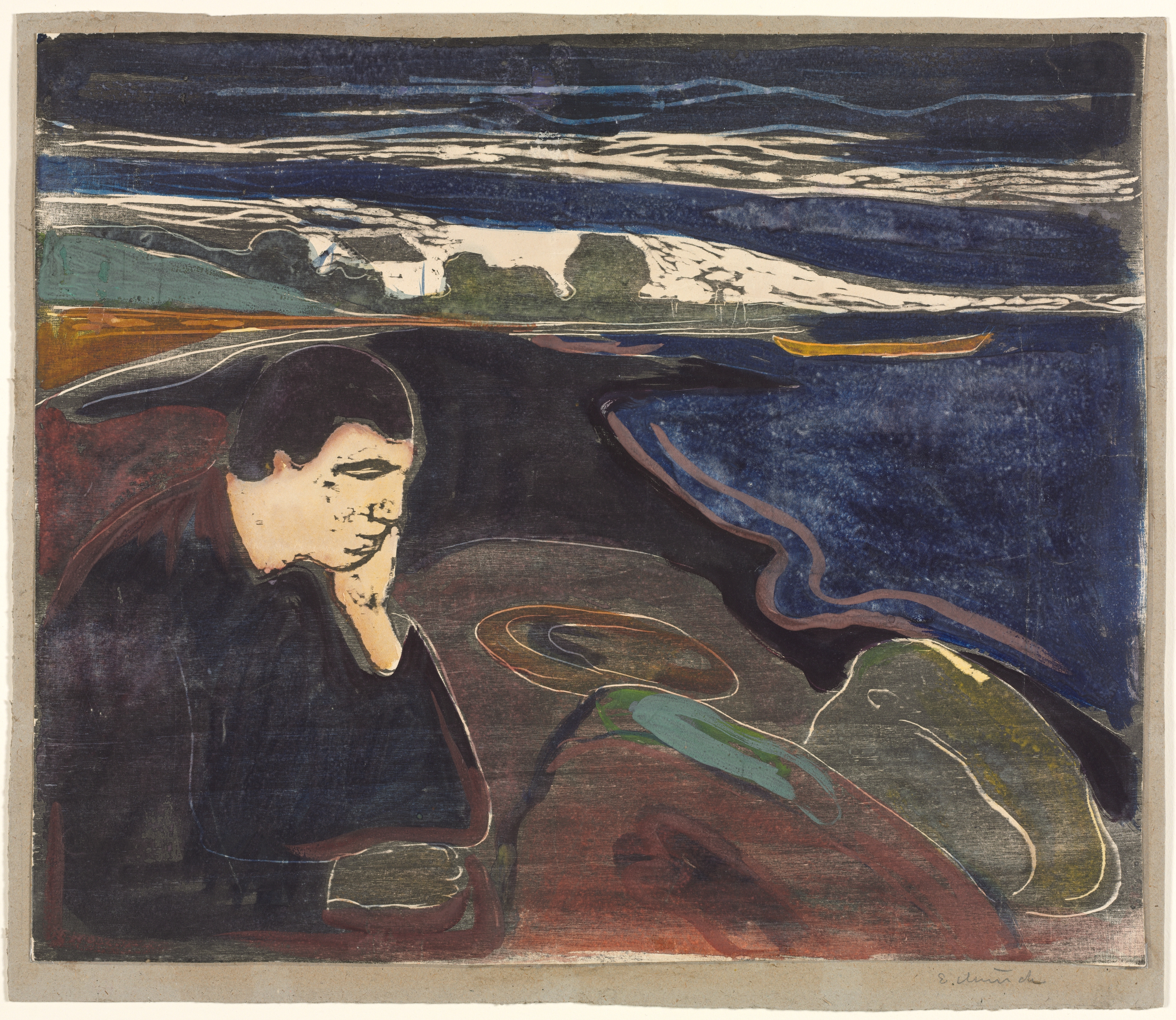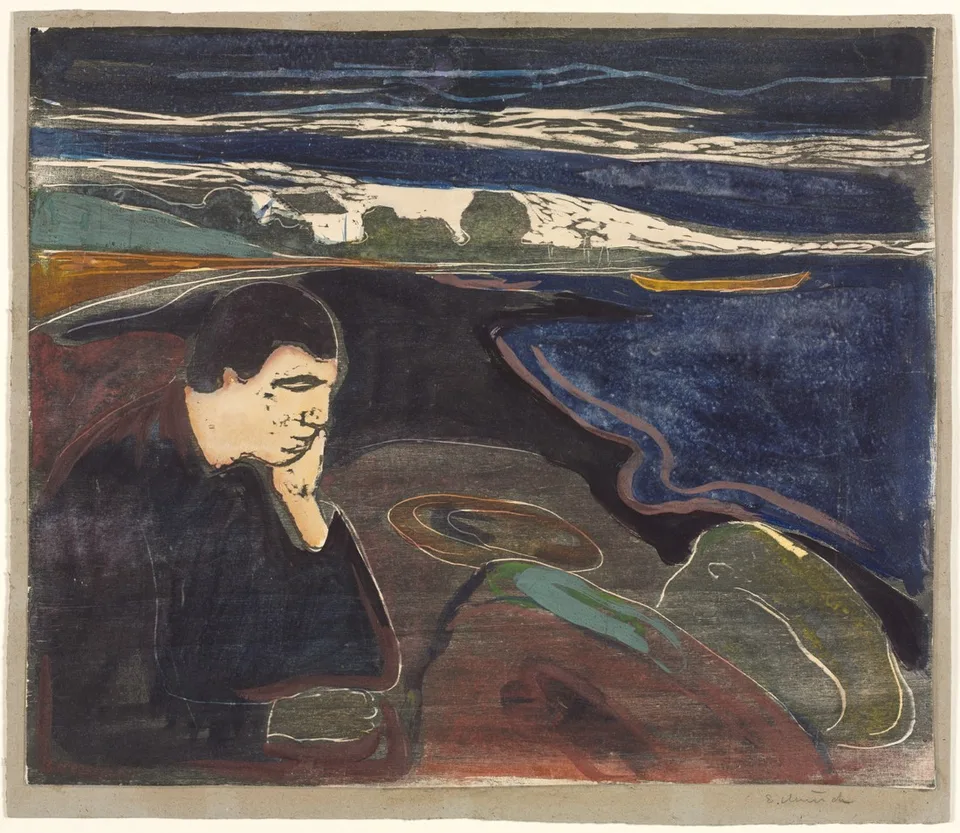
A curving shore seems to carry the sitter’s inward mood outward, while wood grain keeps the image’s making visible.
The man’s pale face and hand form a compact focus at the lower left. The shore then curves away in broad, dark bands, carrying the eye toward a small boat and distant forms. Sea and sky are separated less by realistic depth than by layered colors and irregular horizontal cuts. The image’s space seems to bend and flatten around the solitary figure.
The museum identifies the sitter as Munch’s friend, the critic Jappe Nilssen, at Åsgårdstrand. It relates the subject to romantic disappointment and melancholy. The technique contributes to that reading: Munch chose strongly grained wood, used deliberately rough carving, and added watercolor and gouache to this impression. The result is not simply one identical copy from a plate. Looking at the grain and the colored passages reveals how a reproducible medium could support variation, while the dark hues and simplified forms give the named emotion a material counterpart.
The museum’s identification and account of romantic disappointment supply context. We should not diagnose a real person from the pose, and other impressions may differ substantially in color.