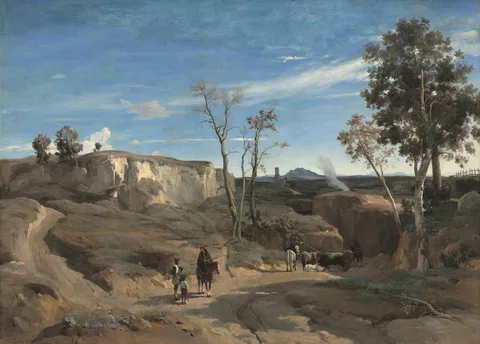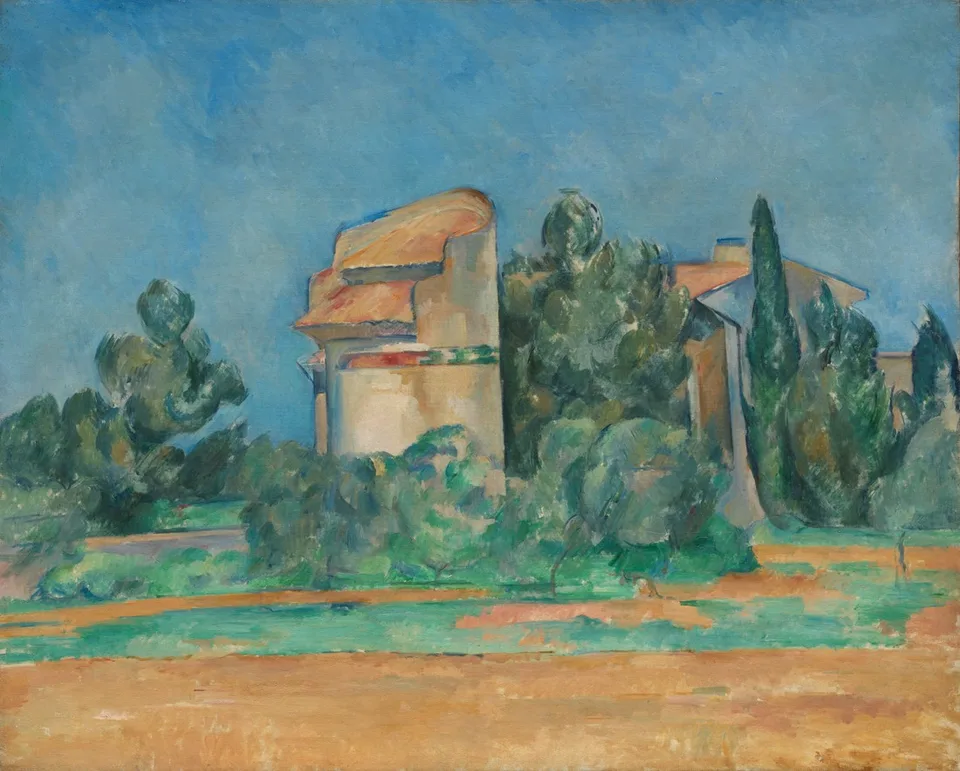
A tower becomes the hinge between orange earth, green trees, and blue sky in a landscape built from broad relationships.
Start with the foreground’s orange strip, then move upward through green vegetation and pale buildings to the blue sky. These large bands establish the picture before any small detail can claim attention. The tower rises among the trees, its curved roof and bright wall answered by both vertical cypresses and softer rounded crowns. Architecture and vegetation differ without belonging to separate pictorial worlds.
The museum describes three principal horizontal planes and connects the warm earth with Provence’s iron-rich soil. Cezanne reduces incidental information to pursue a stable relationship among forms and colors. That stability does not require perfectly straight outlines: edges shift, and short strokes remain visible throughout. Comparing a wall with a neighboring tree shows how the same painted marks can construct different materials. The farm gives the eye recognizable things to hold onto while the arrangement asks us to notice the picture’s larger architecture.
The simplified planes are compositional choices, not a survey of the farm’s measurements. The image cannot tell us the exact agricultural use of every building or tree.