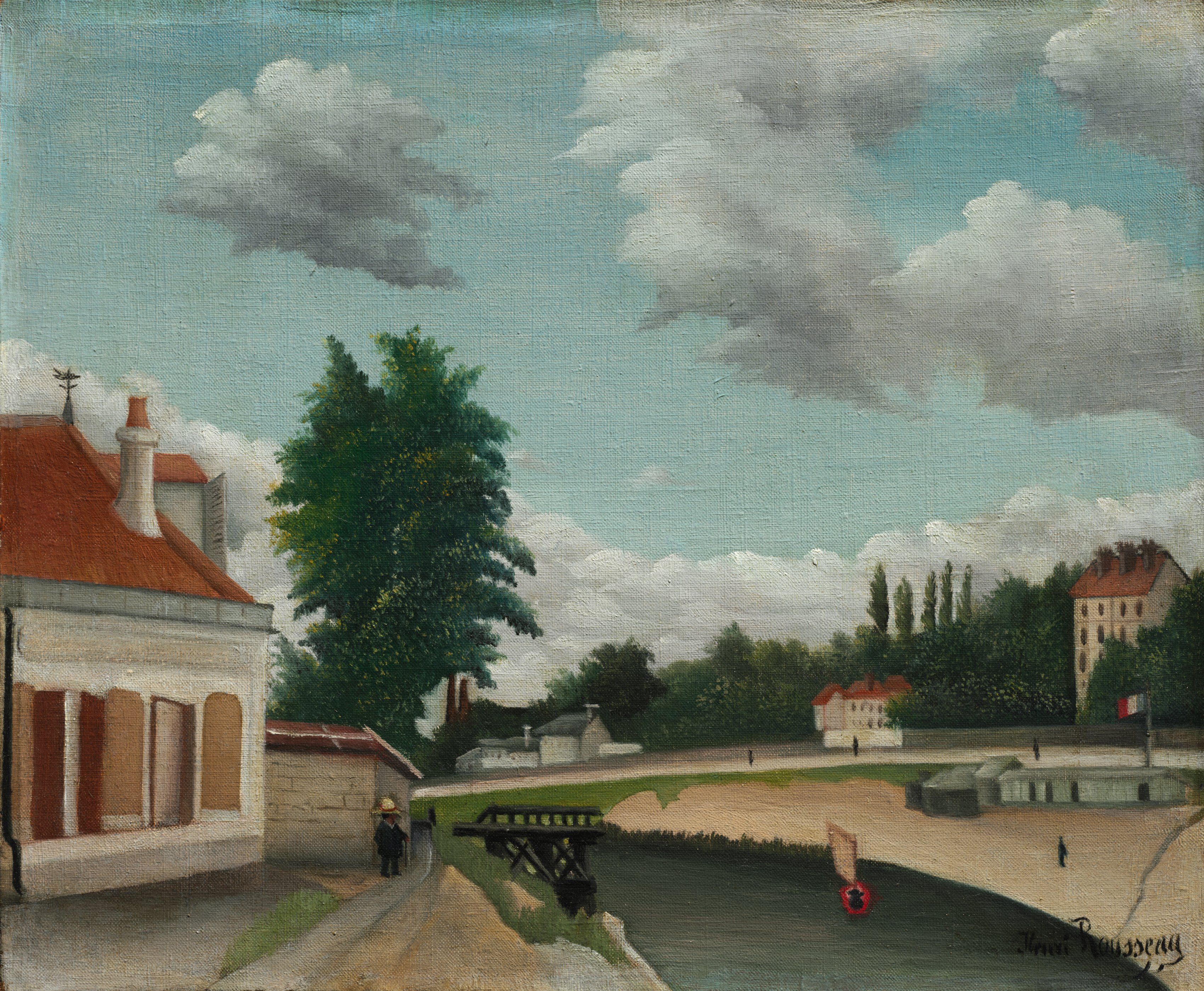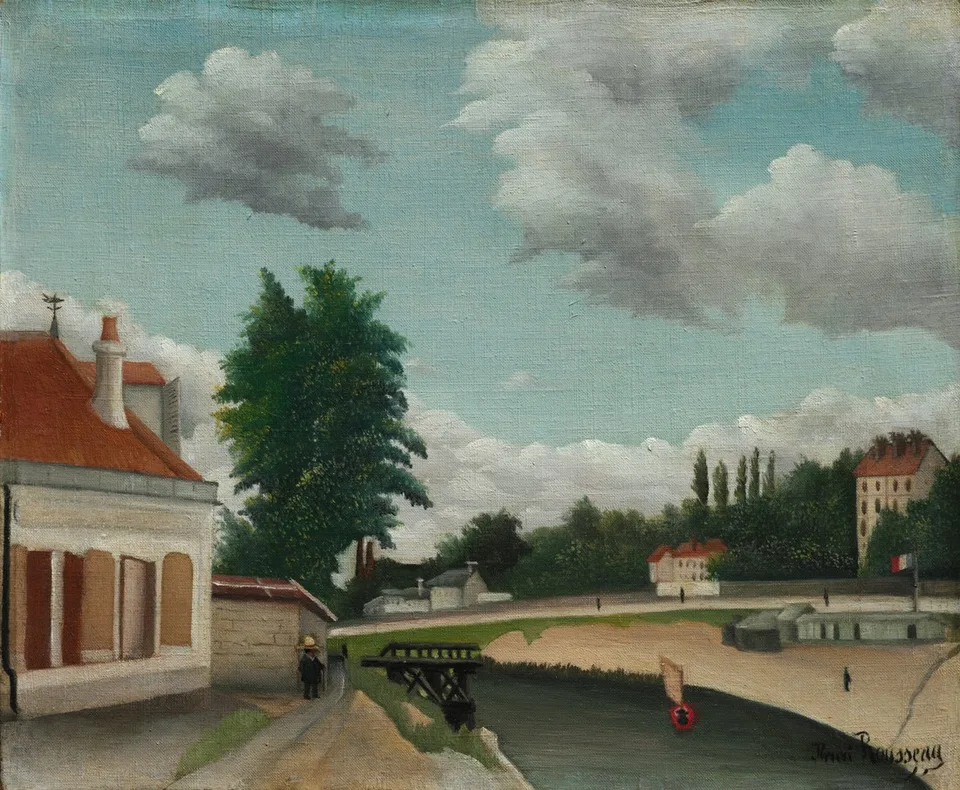
A small bridge and a vast sky make an ordinary suburban waterway feel like a carefully ordered miniature world.
The houses occupy distinct pockets of space. A large white wall anchors the left edge, a smaller building sits across the water, and a taller block rises behind trees at the right. The dark bridge connects the banks near the center, but the water bends away before the entire route becomes visible. Above this measured arrangement, rounded clouds expand across an unusually generous sky.
Rousseau painted smaller landscapes as well as the jungle scenes for which he is best known. The museum identifies this as a river or canal on the outskirts of Paris and notes its combination of clear objects with softer modeling than in some earlier work. Its serenity is therefore constructed through placement and handling. Tiny figures and everyday structures keep the view inhabited, while the strongly separated forms let us discover each element in turn, almost as though reading a simple map that has acquired changing light.
The record leaves open whether this is a river or canal and does not securely name the location. Its orderly design should not be treated as a measured topographic survey.